
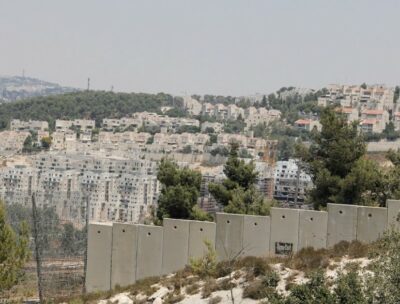
The Jordanian Ministry of Foreign Affairs and Expatriates on Saturday strongly condemned the Israeli government’s decision to approve and “legalize” 19 illegal colonies in the occupied West Bank, describing the move as a flagrant violation of international law and international humanitarian law.
The ministry said the announcement undermines efforts toward a two-state solution and constitutes a clear violation of the Palestinian people’s inalienable right to self-determination, to end the occupation, and to establish an independent sovereign state on the June 4, 1967 lines with East Jerusalem as its capital.
The Jordanian Ministry also stressed that Israel has no sovereignty over the occupied West Bank.
Official spokesperson Ambassador Fouad Majali reaffirmed the Kingdom’s rejection of Israel’s continued settlement projects, calling them an entrenchment of occupation and expansion, and a direct assault on international will to achieve a two-state solution.
He cited UN Security Council Resolution 2334, which condemns all Israeli measures aimed at altering the demographic composition, character, and status of the occupied Palestinian territory since 1967, including East Jerusalem.
He also referred to the advisory opinion of the International Court of Justice, which confirmed the illegality of Israel’s occupation and the nullity of settlement construction and annexation measures in the West Bank.
Jordan urged the international community to shoulder its legal and moral responsibilities, compel Israel to halt its dangerous escalation and unlawful unilateral actions in the occupied West Bank, and ensure the fulfillment of the Palestinian people’s legitimate rights, foremost among them the establishment of their independent state on their national soil.
The ministry stressed that establishing such a state represents the sole route toward a fair and lasting peace, one that secures stability and safety across the region.
All of Israel’s colonies in the occupied West Bank, including those in and around occupied East Jerusalem, are illegal under International Law, the Fourth Geneva Convention in addition to various United Nations and Security Council resolutions. They also constitute war crimes under International Law.
Article 33 of the Fourth Geneva Convention prohibits collective punishment and acts of terror against civilian populations.
Article 49 of the Fourth Geneva Convention states: “The Occupying Power shall not deport or transfer parts of its own civilian population into the territory it occupies.” It also prohibits the “individual or mass forcible transfers, as well as deportations of protected persons from occupied territory”.
Articles 53 and 147, prohibit the destruction of civilian property and classify pillage as a war crime.
