
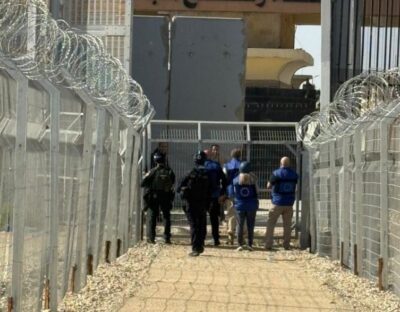
The Rafah Crossing with Egypt saw only limited movement on Sunday as a small group of Palestinians who had completed medical treatment in Egypt were cleared to return to Gaza, while another group of patients from inside the Strip was transported toward the terminal for evacuation.
Although the crossing was formally reopened earlier this month, travel remains tightly restricted, with only a few dozen people allowed through each day.
The Palestinian Red Crescent Society (PRCS) said 44 Palestinians left Gaza on Sunday, among them 19 patients and 27 accompanying relatives.
According to the Government Media Office, 135 Palestinians exited the Strip between February 2 and 5, bringing the total number of departures since the partial reopening to 179.
Officials said 88 Palestinians entered Gaza from Egypt during the same period, a figure that highlights how narrow the window of movement remains.
Raed al‑Nims, media director for the PRCS in Gaza, said evacuation teams continue to move patients out of the Strip “as part of ongoing humanitarian efforts to secure treatment outside Gaza.”
Field data shows that only very small numbers have been permitted to cross in either direction since the terminal resumed minimal operations. The crossing was closed on Friday and Saturday for the weekend before reopening again on Sunday.
“The Israelis left nothing for the people. Everything. They even took the children’s toys.”
A Palestinian woman returning to Gaza from Egypt after Israel reopened the Rafah crossing said soldiers took everything from them, and detained and interrogated them for hours. pic.twitter.com/uwroAhECLq
— Middle East Eye (@MiddleEastEye) February 3, 2026
Egyptian media aired footage from the Egyptian side of the crossing showing buses and vehicles designated for returning Palestinians waiting at the gate, along with logistical and security preparations meant to manage movement once clearance procedures are completed.
Rafah, Gaza’s only gateway to the outside world not directly controlled by Israel, has been under Israeli military control since May 2024, when Israeli forces invaded and seized the Palestinian side of the terminal.
Movement has been almost entirely halted since then, with only rare exceptions. Before the takeover, Rafah served as the main exit point for patients, students, and travelers. Its closure has stranded thousands abroad and prevented critically ill patients from leaving Gaza for treatment.
Gaza’s health system has collapsed under two years of continuous Israeli bombardment and siege. Hospitals operate with minimal capacity, lacking electricity, equipment, and essential medicines.
Humanitarian agencies estimate that around 20,000 patients require treatment outside Gaza, and more than 1,000 died last year while waiting for medical evacuation. Many of those now permitted to leave are in critical condition, including cancer patients, amputees, and children with severe injuries.
The February 2 reopening was part of a limited arrangement involving Israel, Egypt, and the EU, but the daily numbers allowed to cross remain far below the needs of the population.
Civil society groups warn that the current system does not meet humanitarian requirements and that Israel continues to impose arbitrary restrictions on who may travel. Thousands of Palestinians remain stranded in Egypt and other countries, unable to return home.
The slow movement through Rafah has become a stark measure of the broader humanitarian crisis.
Even after a nominal ceasefire, Israeli forces continue to invade neighborhoods, impose military roadblocks, and restrict civilian movement.
Each bus that crosses underscores the thousands who cannot, and the crossing’s partial reopening remains far from sufficient to address the scale of the emergency.
