
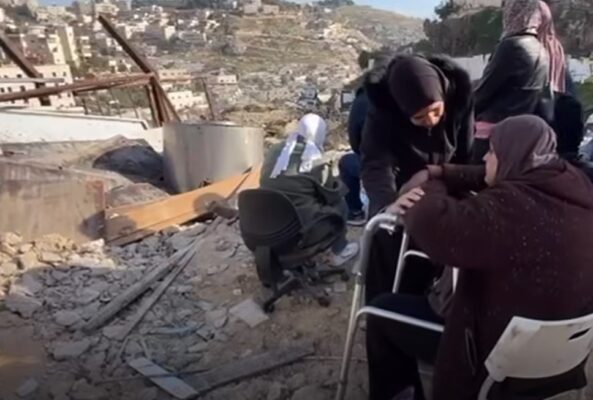
Israeli occupation forces demolished a multi‑story residential building in the Wadi Qaddum area of Ras al‑Amoud in Silwan, south of the Al‑Aqsa Mosque in occupied Jerusalem, early Monday morning, displacing nearly 100 Palestinian residents.
The demolition, carried out under the pretext of lacking an Israeli‑issued building permit, is among the largest recorded in the city this year.
Local sources said the structure contained 13 apartments housing around 100 people, including families with children and elderly residents.
Before dawn, Israeli forces sealed off the entire Wadi Qaddum area, deploying large numbers of soldiers and several bulldozers that invaded the neighborhood and surrounded the building.
Witnesses reported that Israeli forces assaulted men and women as they cordoned off the area and began the demolition.
Soldiers also abducted two Palestinians, Yasser Abu Sneina and the minor Amr Abu Hatab, from the vicinity of the building.
Residents said soldiers broke down doors while families were asleep, ordering them to evacuate immediately and allowing them to take only essential documents and clothing.
Many were left standing in the street as bulldozers tore through their homes, scattering personal belongings across the area.
By midday, most of the building had been reduced to rubble, with Israeli forces positioned on rooftops of nearby homes and blocking all access roads to the neighborhood.
“All for nothing,” said the elderly Jerusalemite woman Umm Amir Bader, reflecting on the demolition of her home in the Silwan neighborhood, where she had lived for 11 years.
“I went to the Israeli courts to appeal the demolition orders. I went to the City Council and submitted every document they asked for, but nothing helped. They searched me, made me wait for hours, and even took my belongings,” she said. “I begged them to let me take my furniture and personal items. I told them I needed my diabetes medication, I need my belonging, I need to use the bathroom…but they didn’t listen. I’ve lost everything. I worked in a hotel for fifteen years and saved every penny to buy this home… and now it’s all gone, I do not even have my medicine…”
She had purchased the property with the savings of 15 years of work, finally securing a place to live with her son. Today, all of it — the money, the labor, the years of sacrifice — was reduced to rubble in the cold morning air.
During the brutal and violent invasion of her home, she said soldiers denied her access to the bathroom and to her essential medications, and forcibly removed her from the house without any regard for her age or disability.
Also in Jerusalem, Israeli occupation forces demolished a commercial structure on Monday in the Bab al‑Amoud (Damascus Gate) area of occupied Jerusalem.
Local sources said a military unit invaded the neighborhood and tore down the structure shortly after sealing off the surrounding area.
In recent months, Israeli authorities have sharply increased the demolition of shops, kiosks, and street vendors’ stalls in the Bab al‑Amoud area — a central artery of daily life for Palestinians in Jerusalem. The area serves as a major commercial hub, especially for small businesses and vendors who rely on foot traffic around the historic gate
Rights groups described the demolition as the largest carried out in Jerusalem this year, noting that dozens of Palestinian families have already lost their homes in similar operations.
The building had been tied up in a years‑long legal process, and residents had submitted a planning proposal in 2022 to regulate the structure.
A meeting with the municipality’s legal adviser was scheduled for later on Monday, but the demolition began hours before it was due to take place.
Palestinian officials and human rights organizations say the demolition is part of a systematic policy aimed at forcibly displacing Palestinians from occupied Jerusalem while expanding Israeli illegal colonies in and around the city.
The Jerusalem Governorate condemned the operation as an act of forcible transfer, noting that Israel routinely denies Palestinians building permits and then demolishes their homes.
Under international humanitarian law, including the Fourth Geneva Convention, the destruction of civilian property in occupied territory is prohibited unless absolutely required for military necessity — a condition rights groups say does not apply in this case.
Several families said they had nowhere to go. One resident told reporters that his seven‑member family would be forced to sleep in their car after being evicted without warning. Another woman said she watched soldiers destroy her bedroom as she stood outside in shock.
The demolition adds to the growing number of Palestinian families displaced in Silwan, one of the most heavily targeted neighborhoods in occupied Jerusalem, where Israeli authorities have intensified demolitions and colonialist expansion in recent years.
In related news, Israeli occupation forces issued stop‑construction notices on Monday for four Palestinian homes in the village of al‑‘Asakra, east of Bethlehem.
Media sources said the notices targeted homes belonging to Fadel and Hamza Saud Asakra, as well as Ahmad and Mohammad Sa’id Asakra, under the pretext of lacking Israeli‑issued building permits.
While Israel continues to build and expand its illegal colonies, Palestinian communities and towns in occupied Jerusalem and various areas in the occupied West Bank continue to be denied the right to build homes and property under various allegations meant to prevent the expansion of Palestinian towns and neighborhoods.
All of Israel’s colonies in the occupied West Bank, including those in and around occupied East Jerusalem, are illegal under International Law, the Fourth Geneva Convention in addition to various United Nations and Security Council resolutions. They also constitute war crimes under International Law.
Article 33 of the Fourth Geneva Convention prohibits collective punishment and acts of terror against civilian populations.
Article 49 of the Fourth Geneva Convention states: “The Occupying Power shall not deport or transfer parts of its own civilian population into the territory it occupies.” It also prohibits the “individual or mass forcible transfers, as well as deportations of protected persons from occupied territory”.
Articles 53 and 147, prohibit the destruction of civilian property and classify pillage as a war crime.
