
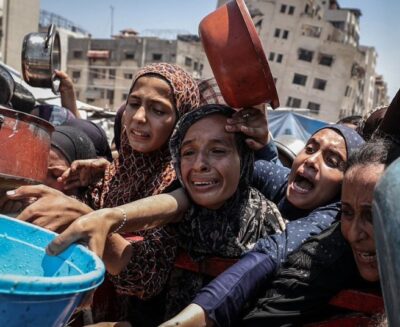
Doctors Without Borders (MSF) has warned that humanitarian assistance reaching Gaza remains gravely insufficient, despite the ceasefire announced on October 10. Emergency coordinator Caroline Seguin cautioned that without a significant improvement, displaced families will again face the harsh conditions of winter.
Seguin stressed that the ceasefire is extremely fragile and violations continue to claim Palestinian lives. “Yes, there is a ceasefire, and the situation is somewhat better, but the suffering has not ended,” she said in a press statement.
She noted that most attacks originate from the area the Israeli military has designated as the “yellow line” in Khan Younis, where occupation forces remain deployed.
Civilians, she explained, do not know the precise boundaries of this zone. “Just two days ago, helicopter fire landed dangerously close to our health center in al‑Mawasi. We cannot tell where they were aiming. What we do know is that such incidents occur near, and sometimes beyond, that line.”
According to MSF, humanitarian aid has nearly ground to a halt since the ceasefire began. No health facility in Gaza is operating at full capacity, and medical teams are struggling to maintain even basic services.
Seguin emphasized the urgent need to scale up medical and humanitarian supplies to sustain clinics, vehicles, and infrastructure.
Displaced families, she added, are increasingly angry that insufficient numbers of tents have entered Gaza to shield them from rain and cold.
MSF has called on the international community and states with influence over Israel to exert pressure to allow the entry of essential materials into Gaza.
