
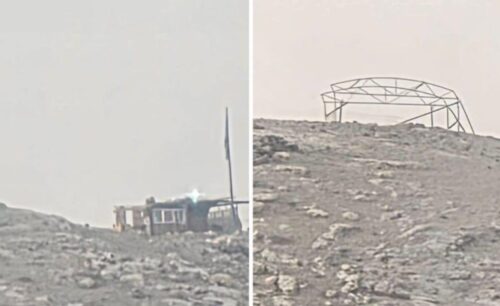
Illegal paramilitary Israeli colonizers established a new outpost on Sunday near the Bedouin communities of Abu Ghaliya and al-‘Arara, east of the town of ‘Anata in occupied East Jerusalem.
The construction—consisting of mobile home foundations and heavy equipment—poses an immediate threat to local residents, restricting access to their homes and grazing lands.
Hassan Mleihat, general coordinator of the al-Baydar Rights Organization, confirmed that the outpost is part of a systematic policy to seize land and expand colonial presence in the area.
The move follows a surge in colonialist planning: since October 7, 2023, Israeli authorities have advanced 182 structural plans for 23,267 colonial housing units across 14,000 dunums. Of these, 6,300 units have already been approved, while 17,000 remain pending.
Jerusalem is the epicenter of this expansion, with 65 structural plans—25 outside the municipal boundaries and 40 within.
Additional plans target Salfit and Bethlehem (22 each), reflecting a coordinated push to entrench control across the West Bank.
In parallel, colonizers—backed by Israeli forces—have erected 29 new outposts, including 8 in Hebron, 6 in Ramallah, 4 in Bethlehem, and 3 in Nablus.
Seven new segregated roads have been carved to connect these outposts to existing colonies.
The Israeli government has also moved to “legalize” 11 outposts, converting them into formal colonies or annexed neighborhoods, while initiating procedures to regularize 9 more.
The outpost near ‘Anata is not an isolated act—it is part of a state-backed strategy of spatial apartheid and forced displacement, targeting vulnerable Bedouin communities and accelerating the fragmentation of Palestinian land.
On Sunday evening, Israeli colonizers set fire to dozens of olive trees in the village of Majdal Bani Fadel, south of Nablus in the occupied West Bank’s northern part.
On Sunday morning, a Palestinian man was injured after being assaulted by illegal paramilitary Israeli colonizers in the village of Umm al-Khair, in Masafer Yatta, south of Hebron in the southern part of the occupied West Bank.
On Saturday, Israeli occupation forces and illegal paramilitary colonizers launched coordinated assaults across the occupied West Bank, targeting Palestinian towns, refugee camps, and agricultural lands, resulting in injuries and property destruction.
On Saturday morning, illegal Israeli colonizers attacked citizens and international activists while they were picking olives in the village of Burin, south of Nablus in the northern occupied West Bank.
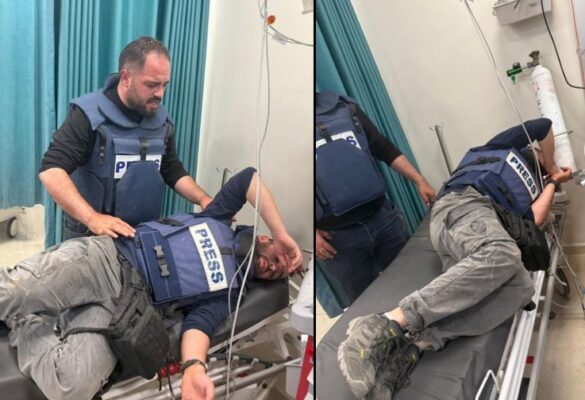
Earlier Saturday, six Palestinians—including volunteer medics, journalists, and a local farmer—were injured during an assault by illegal paramilitary Israeli colonizers in the town of Beita, south of Nablus.
This escalation follows the killing of two Palestinian children—Mohammad Abdullah Taym (16 years old) and Mohammad Rashad Fadl Qasim (16 years old), by Israeli forces the previous night. The boys were shot near the apartheid wall in the upper neighborhood of Al-Jadira. Their bodies remain withheld by the occupation.
Also Saturday, Israeli colonizers stole olive crops from Palestinian land in the town of Aqraba, located south of Nablus.
The occupied West Bank witnessed an unprecedented surge in violations by illegal Israeli paramilitary colonizers—during October 2025, marking the highest monthly toll in nearly two decades, the United Nations said.
n the early hours of Saturday morning, Israeli colonizers set fire to a Palestinian home in the village of Abu Falah, northeast of Ramallah in the occupied West Bank’s central part.
 On Friday, Israeli colonizers demolished residential tents and livestock shelters belonging to Palestinian residents in Khirbet Hamsa, in the northern Jordan Valley of the occupied West Bank, on Friday.
On Thursday, Israeli colonizers carried out a number of attacks, injuring a child and destroying olive trees, after targeting Palestinians and their property, in the occupied West Bank.
Furthermore, Israeli colonizers invaded the Bedouin community of Al-Hathrawa near Khan al-Ahmar, east of occupied Jerusalem in the West Bank, and demolished four mobile homes used by local families.
The Wall & Colonization Resistance Commission documented 766 colonizer attacks in October alone, concentrated in the districts of Ramallah and Al-Bireh (195), Nablus (179), and Hebron (126). These included 352 incidents of theft and vandalism targeting Palestinian property and farmland.
Among the victims was Jihad Mohammad Ajaj, 26, from Deir Jarir, who was shot and killed by colonizers in a direct armed assault. His death brings the number of Palestinians killed by colonizer gunfire since the start of 2025 to 14.
Colonizer violence, often carried out with the backing of Israeli occupation forces, also led to the uprooting, burning, and poisoning of over 1,200 olive trees—an emblem of Palestinian heritage and sustenance.
It is worth mentioning that, on Wednesday, Israeli occupation authorities issued two new tenders for the construction of a colonial neighborhood in the illegal colony of Adam (Givat Binyamin), built on stolen Palestinian land northeast of occupied Jerusalem.
All of Israel’s colonies in the occupied West Bank, including those in and around occupied East Jerusalem, are illegal under International Law, the Fourth Geneva Convention in addition to various United Nations and Security Council resolutions. They also constitute war crimes under International Law.
Article 33 of the Fourth Geneva Convention prohibits collective punishment and acts of terror against civilian populations.
Article 49 of the Fourth Geneva Convention states: “The Occupying Power shall not deport or transfer parts of its own civilian population into the territory it occupies.” It also prohibits the “individual or mass forcible transfers, as well as deportations of protected persons from occupied territory”.
Articles 53 and 147, prohibit the destruction of civilian property and classify pillage as a war crime.
