
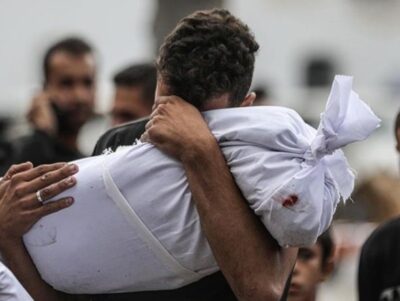
As the declared ceasefire now in its fifth day, Gaza continues to endure devastating loss. According to medical sources, nine Palestinians were pronounced dead at hospitals across the Strip between midnight and 12:30 p.m. on Tuesday, in addition to 250 bodies found under rubble.
Of these, six were received at the Baptist Hospital and three at Nasser Hospital, while no new cases were reported at Shifa, Al-Aqsa, or Al-Awda hospitals.
Seven of the slain Palestinians were killed on Tuesday, while two succumbed to injuries sustained in earlier attacks, WAFA Palestinian News & Info Agency said.
Al-Jazeera said the Israeli military claimed that it opened fire to neutralize what it described as a potential threat, after spotting individuals it deemed suspicious attempting to cross the designated yellow line in Gaza.
According to the army, those individuals continued to approach its forces despite warning shots being fired.
Meanwhile, in the northern part of the Strip, emergency services reported that several Palestinians were wounded by Israeli gunfire in the Halawa area of Jabalia town.
Also, An Al Jazeera correspondent reported that Israeli tanks fired heavily at Palestinians in the northwestern outskirts of Rafah city.
Palestinian sources also confirmed gunfire from Israeli military vehicles and the presence of drones flying over the Shakoush area in northern Rafah.
Furthermore, the World Health Organization has raised alarm over the deteriorating health situation in Gaza, reporting that more than 15,600 patients urgently need to be evacuated for treatment outside the Strip.
It also revealed that over 15,000 people have suffered limb amputations, and called for stronger disease surveillance in light of collapsing health infrastructure and worsening sanitary conditions.
WHO stressed the importance of reopening medical corridors to allow access to specialized care and emergency services, warning that continued closures and delays in medical aid could significantly worsen the humanitarian and health crisis.
The ongoing humanitarian crisis is compounded by the grim task of recovery. Rescue teams have retrieved more than 250 bodies since the cessation of bombing, many found scattered in streets or buried beneath rubble.
Teams face severe shortages in heavy machinery, leaving over 10,000 people still trapped under collapsed buildings.
In parallel, the Ministry of Health announced its readiness to receive the remains of Palestinians expected to be released by Israeli authorities.
Through its Martyrs’ Remains Management Committee, the ministry affirmed that forensic teams, paramedics, nurses, and technical staff are fully prepared to conduct dignified reception, examination, documentation, and handover procedures. These efforts aim to honor the sanctity and the dignity of the fallen.
The ministry emphasized that its personnel continue to fulfill their humanitarian and professional duties under extreme conditions and limited resources, reaffirming their commitment to preserving human dignity—both in life and in death.
This update aligns with ongoing reports of Israeli violations, including drone strikes and gunfire in areas supposedly covered by the ceasefire.
Earlier Article:
Army Kills Three Palestinians, Two Die from Wounds, in Gaza
Since October 7, 2023, Israeli attacks have killed at least 67,869 Palestinians and wounded more than 170,000. Thousands remain trapped under rubble or stranded in inaccessible areas, as rescue teams face ongoing obstruction and bombardment.
The ceasefire, brokered by international mediators, was intended to facilitate a phased Israeli withdrawal and allow displaced families to return. Yet violations persist. Israeli forces continue to shell parts of Khan Younis and maintain control over large sections of Gaza City and Rafah—effectively nullifying the promise of safe return.
Humanitarian conditions remain dire. Aid convoys are routinely blocked, and civilians risk death simply trying to reach food or medical care. Since May 2025 alone, more than 2,600 Palestinians have reportedly been killed while attempting to access basic necessities.
The situation on the ground reveals a grim reality: the ceasefire seems to exist on paper, but not in practice. Without international enforcement and accountability, Gaza remains under siege—its people caught between rubble and sniper fire, ceasefire declarations, and drone strikes.
In the past 24 hours alone, hospitals in Gaza received 44 fatalities—38 of them recovered from beneath the rubble—and 29 wounded.
Emergency and civil defense crews continue to face immense challenges in reaching victims trapped under debris or lying in the streets, as widespread infrastructure collapse and severe shortages of equipment and supplies severely hinder rescue efforts.
