
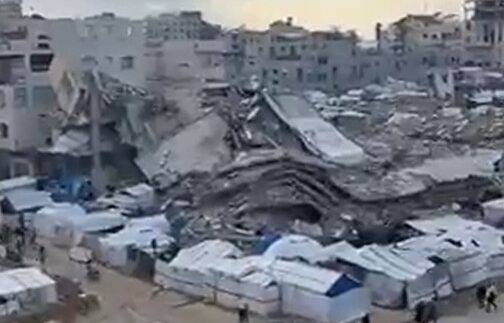
A Palestinian man was killed on Wednesday after Israeli forces opened fire east of Khan Younis in southern Gaza, as the devastated Gaza Strip continues to face severe humanitarian shortages despite limited aid deliveries through Rafah and Kerem Shalom.
The Health Ministry in Gaza reported new casualties and warned that many victims remain trapped under rubble amid the ongoing inability of rescue teams to reach large parts of the devastated enclave.
The Ministry of Health said Maher Harb Ahmad Samour, 43, was shot by Israeli forces east of Khan Younis and died from his wounds shortly afterward.
Heartbreaking scene as two young girls bid farewell to their father, Maher Samour, who was killed by Israeli forces east of Khan Younis. pic.twitter.com/yUSozqwSLy
— PALESTINE ONLINE 🇵🇸 (@OnlinePalEng) March 4, 2026
The killing comes as displaced families attempt to return to heavily damaged neighborhoods in the area, where Israeli forces continue to enforce no‑go zones and fire toward civilians approaching their homes or farmland.
Humanitarian officials at the Rafah crossing and the Egyptian Red Crescent confirmed that more than one hundred aid trucks entered Gaza on Tuesday, carrying supplies from the United Nations and UNICEF.
The trucks crossed from Egypt through Rafah before continuing to the Kerem Shalom crossing (Karem Abu Salem), which Israel reopened on Tuesday following a temporary closure linked to regional military escalation.
Egyptian Red Crescent officials said the convoy included flour, relief supplies, fuel for hospitals and essential facilities, tents, clothing, and blankets. A second convoy was dispatched Wednesday and was awaiting clearance to enter.
Despite the movement of aid, officials stressed that the volume remains far below what is needed to sustain Gaza’s population.
The UN Office for the Coordination of Humanitarian Affairs said that while some relief items reached Gaza on Tuesday and more were expected Wednesday, the closure of Rafah to regular movement and the reliance on a single Israeli‑controlled crossing continue to severely restrict humanitarian access.
OCHA warned that medical evacuations have halted entirely, and that predictable, sustained access is urgently required to meet the immense needs of the population.
The reopening of “Kerem Shalom” followed what Israeli authorities described as a “security assessment,” after the crossing was shut during joint U.S.–Israeli strikes on Iran over the weekend.
Rafah Crossing with Egypt, Gaza’s only crossing not directly on Israeli territory, resumed extremely limited operations on February 2, but movement through it remains tightly restricted and unpredictable under continued Israeli control.
Humanitarian conditions across Gaza remain catastrophic. Nearly 1.9 million Palestinians—the vast majority of the Strip’s population—are displaced, many living in makeshift tents that offer little protection from weather, disease, or flooding.
Suleiman is just two years old.
At an UNRWA health centre in #Gaza, he receives physiotherapy to support his development.
Through regular sessions, he continues to access the care he needs.
Since Oct 2023, UNRWA has delivered over 172,000 physiotherapy sessions, reaching… pic.twitter.com/4kxQm58eXv
— UNRWA (@UNRWA) March 4, 2026
Aid agencies report that shortages of food, fuel, medicine, and clean water continue to worsen, and that the destruction of infrastructure has left entire districts uninhabitable.
The Health Ministry’s daily report for March 4 recorded one Palestinian killed and three injured in the past 24 hours.
The Ministry said many victims remain under rubble or in areas rescue teams cannot reach due to ongoing military restrictions. Since the declared ceasefire on October 11, the Ministry has documented 633 Palestinians killed, 1,703 injured, and 753 bodies recovered from destroyed areas.
Cumulative figures since the start of the war on October 7, 2023, show 72,117 Palestinians killed and 171,801 injured, alongside the destruction of nearly all civilian infrastructure.
Gaza was the precedent, the prologue, and the beginning. https://t.co/NbhXYa58zq
— Jehad Abusalim (@JehadAbusalim) March 4, 2026
The Ministry described the situation as a continuing humanitarian collapse, with hospitals operating far beyond capacity and lacking essential supplies.
The limited aid entering Gaza through Rafah and Kerem Shalom has provided temporary relief but remains insufficient to address the scale of need.
Humanitarian agencies continue to call for additional crossings to be opened, the restoration of medical evacuation routes, and unimpeded access to all parts of the Strip.
