
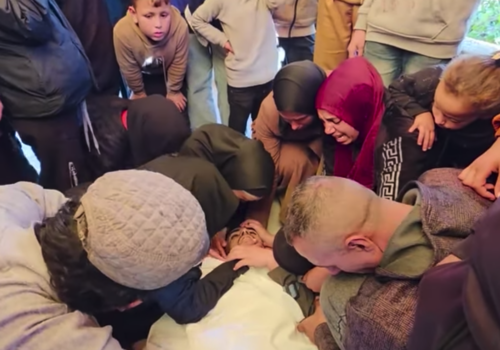
Israeli forces shot and killed a young Palestinian man on Friday evening east of Khan Younis, in southern Gaza, in yet another sign of how hollow the so‑called “ceasefire” of October has become.
The victim, Firas Ahmad Muhammad Abu Shanab, was in his twenties. Medical teams said he died from gunshot wounds after Israeli soldiers opened fire in Bani Suheila.
Neighbors described hearing sudden bursts of live ammunition and seeing Abu Shanab collapse as he tried to move between nearby homes.
Not long after, the north of the Strip was hit again. Israeli artillery shells slammed into residential blocks in Beit Lahia, critically injuring four Palestinians and tearing through several homes.
Paramedics said they struggled to reach the wounded because the shelling continued even as they tried to pull people from the rubble.
One medic described the scene as “running through dust and shrapnel, hoping the next round doesn’t land on us.”
Despite the ceasefire framework, the pattern has remained largely unchanged. Israeli forces continue to fire on civilians, launch drone strikes, shell neighborhoods, and demolish homes across a Gaza Strip already pushed to the edge.
Since the “ceasefire” took effect on 11 October 2025, these violations have killed at least 417 Palestinians and injured 1,153.
The broader toll of the genocide, stretching back to October 7, 2023, has now climbed past 71,000 killed and 171,000 wounded, with medical teams warning that many more remain unaccounted for beneath collapsed buildings or unreachable due to ongoing fire.
The violations are unfolding alongside a brutal winter storm that has turned displacement camps into pools of freezing water. From Deir al‑Balah to Gaza City, families living in makeshift tents have watched the rain soak their blankets, their food, and the last of their belongings.
Children shiver through the night, and elderly people struggle to breathe in the cold, damp air.
Doctors report rising cases of hypothermia, respiratory infections, and waterborne illnesses as clean water becomes harder to find.
