
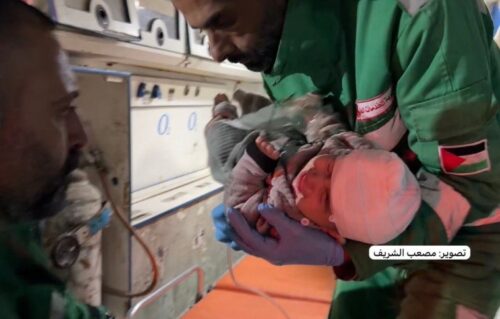
A Palestinian civilian was killed Monday, and several others were wounded when Israeli occupation forces carried out a strike targeting a group of residents in the al‑Saftawi area north of Gaza City, medical staff at al‑Shifa Hospital confirmed.
The attack comes as hospitals across the Strip report eight fatalities and 17 injuries in the past 24 hours, underscoring the ongoing pattern of daily casualties despite repeated claims of de‑escalation.
Omar is one of tens of thousands of children in Gaza whose childhoods were shattered by this war.
He lost his father, his brother, and dozens of family members in a single Israeli airstrike.
Since October 2023, Israel’s war on Gaza has left more than 58,000 children without one… pic.twitter.com/afEryNFuQY
— Quds News Network (@QudsNen) March 17, 2026
The latest death raises the number of Palestinians killed since the October 11, 2025 “ceasefire” period to 672, with more than 1,754 wounded and 756 bodies recovered from beneath destroyed buildings during that same timeframe.
The Israeli army released footage showing the moment they attacked a police vehicle in the central Gaza Strip yesterday, killing eight police officers and injuring dozens. pic.twitter.com/JvfHsXiNzL
— Quds News Network (@QudsNen) March 16, 2026
Broader cumulative figures since the beginning of the genocide in Gaza on October 7, 2023, now stand at 72,247 killed and 171,878 injured, reflecting the scale of destruction and the sustained intensity of military operations across the Strip.
|Israeli Airstrike Kills Family in Central Gaza|
Residents in northern Gaza reported that the strike hit an area where civilians had gathered, adding to the sense of insecurity that has persisted even in neighborhoods previously considered relatively calmer.
Local journalists and emergency workers noted that the attack triggered renewed displacement as families fled deeper into already overcrowded districts in search of temporary safety.
No words،،
If you see this video, put a dot to break the algorithm.💔🍉 pic.twitter.com/MrbtpyoorG— GHADA 🇵🇸 (@ghadaa231) March 16, 2026
Humanitarian conditions continue to deteriorate sharply. Hospitals are operating with severe shortages of fuel, anesthesia, antibiotics, and trauma supplies, forcing medical teams to ration care and postpone surgeries that would normally be considered urgent.
|Israel Bombs Gaza, Killing Nine Palestinian Police Officers; 15 Killed in Past 24 Hours|
Several facilities report that generators are running at critically low levels, threatening neonatal units, dialysis wards, and intensive care services.
Doctors warn that preventable deaths are rising due to delayed treatment and the inability to stabilize patients with complex injuries.
Food insecurity is worsening as aid deliveries remain sporadic and insufficient. Long lines form daily around makeshift distribution points where families wait for flour, canned goods, and limited water supplies.
Humanitarian agencies describe the situation as “beyond emergency,” noting that the collapse of sanitation systems and overcrowded shelters is increasing the risk of disease outbreaks.
