
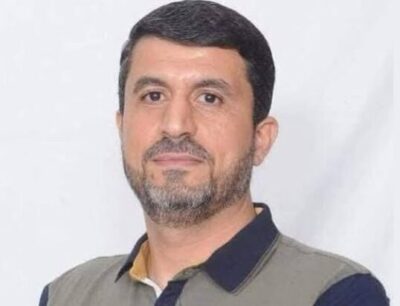
Palestinian rights groups warned of the rapidly worsening health of detainee Akram al‑Qawasmi, a Jerusalemite Palestinian political prisoner, held in the Israeli Gilboa prison.
The Prisoners’ Information Office said al‑Qawasmi, who is serving two life terms, is now in critical condition after repeated assaults by Israeli prison guards, leaving him unable to move without assistance. Fellow detainees have been forced to carry him inside the facility due to his rapidly deteriorating health.
Recently released detainees from occupied Jerusalem informed the family that guards have been isolating and attacking al‑Qawasmi daily. He reportedly asked them to convey an urgent appeal to organizations working on prisoners’ rights to intervene immediately.
Former detainees said Israeli guards have been invading prisoners’ cells every day since the end of Ramadan, beating detainees with batons before singling out al‑Qawasmi for additional assaults.
They described him as a prominent figure within the prisoners’ movement and said his affiliation with Hamas made him a target. One guard allegedly threatened him, telling him he would be “the first to die.”
A source following the case said the repeated blows to al‑Qawasmi’s head caused internal bleeding and severe neurological damage, leaving him with major loss of hearing and vision on his right side and partial loss on his left, Al-Jazeera said.
The source said al‑Qawasmi had been in good health until Ramadan and had no prior medical issues, describing the current situation as “slow death.”
Al‑Qawasmi, 52, is originally from Hebron in the southern occupied West Bank, though his family has lived for decades in the Ras al‑Amoud area of Silwan, south of the Al‑Aqsa Mosque.
He was abducted on March 27, 1996, after allegedly joining the al‑Qassam Brigades in 1994 and participating in operations carried out following the assassination of the group’s leader, Yahia Ayyash.
During his imprisonment, he completed several academic degrees, including a doctorate in Jerusalem studies.
The Prisoners’ Information Office held Israeli authorities fully responsible for his life, citing ongoing medical neglect and systematic abuse inside prisons.
