
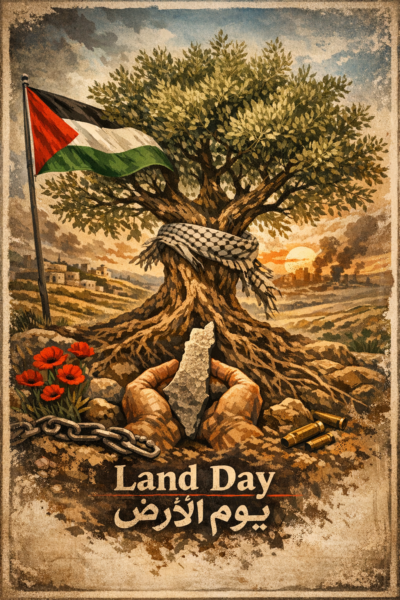
The head of the Wall & Colonization Resistance Commission, Moayyad Sha’ban, said that the 50th anniversary of Land Day, which arrives this year as a renewed affirmation of the centrality of land in the Palestinian national consciousness, describing it as the core of the struggle, its historical and political anchor, and the steadfastness of the Palestinian People.
In a statement issued by the Commission, he recalled that on 30 March 1976, Palestinians presented a defining model of collective resistance against land confiscation and uprooting, turning Land Day into one of the most enduring symbols of national steadfastness in contemporary Palestinian history.
Sha’ban stressed that marking Land Day today is not merely a commemorative act, but a political assertion of Palestinians’ attachment to their land and rights, and their rejection of all attempts at erasure, dispossession, and colonization.
This year’s anniversary, he said, comes amid an increasingly complex reality in which colonial measures to seize land and impose new facts on the ground are accelerating at unprecedented levels.
According to the Commission’s spatial data, approximately 61% of the West Bank falls within Area C, where Israeli authorities maintain full civil and military control. More than 70% of Area C is subjected to colonial classifications such as “state land,” “nature reserves,” and “military training zones.”
The official noted that around 15% of the West Bank has been declared “state land,” with the vast majority allocated for colonial expansion. An additional 18% has been designated as military training areas where Palestinians are barred from entering, cultivating, or using the land, while Israeli colonizers are allowed to infiltrate and establish outposts.
He added that the built‑up areas of colonies and their zones of influence now cover 12.4% of the West Bank, while colonial bypass roads control more than 3% of the territory.
Combined, these systems impose effective control over more than 42% of the West Bank, sharply restricting Palestinian development in what he described as a deliberate colonial strategy aimed at eliminating the possibility of a geographically contiguous Palestinian state.
The number of colonies and outposts has surpassed 542 sites, including 350 outposts and 192 colonies, housing more than 780,000 Israeli colonizers.
Meanwhile, Israeli authorities continue to issue military orders and planning schemes targeting thousands of dunams annually.
The Commission’s head said that after October 7, 2023, colonizer violence evolved from sporadic attacks into a systematic tool for reshaping geographic space, particularly in Bedouin and agricultural areas.
Armed colonizer militias, operating with political and security cover, forcibly displaced 79 Palestinian Bedouin communities, either partially or entirely, affecting 814 families and more than 4,700 people — one of the largest waves of forced displacement in recent decades.
He emphasized that this displacement is not incidental but part of a coordinated effort to empty strategic areas in Area C and around major colonial blocs, preparing them for future annexation or expansion.
The Commission’s data also shows a dramatic surge in new colonial outposts since October 2023, with 165 new outposts established — 59 of them in 2025 alone. These outposts typically begin as small encroachments that quickly evolve into larger expansions supported by military protection and infrastructure, enabling control over vast areas and the isolation of Palestinian communities.
Israeli planning bodies have reviewed 390 structural plans for West Bank colonies, including those in Jerusalem, since October 2023. The unusually high number of plans signals an intention to launch the largest wave of colonial expansion in years, including 54 newly announced colonial sites, some of which will be built from scratch.
He warned that such decisions will lead to further land seizures, restrictions, and displacement, describing the colonial project as a “rolling fireball” that continuously expands at the expense of the Indigenous Palestinian population.
Since October 2023, Israeli authorities have issued more than 1,800 demolition notices, including 991 in 2025, concentrated mainly in Hebron, Bethlehem, Ramallah, al‑Bireh, and Jerusalem. In 2025 alone, Israeli forces demolished 1,400 Palestinian structures.
The number of permanent and temporary military roadblocks, gates, and earth mounds has reached 925, creating a fragmented archipelago of isolated Palestinian enclaves — a defining feature of the deepening apartheid system.
The Annexation Wall, built starting in 2002, continues to isolate more than 295 km² of Palestinian land. If completed as planned, it will isolate 560 km², nearly 9% of the West Bank, with severe and lasting economic and social consequences.
The Commission’s head concluded by calling Land Day a national moment to rally around popular resistance and defend Palestinian land and resources.
He urged the activation of night protection committees, especially in areas facing repeated attacks by armed colonizers, describing them as essential to safeguarding Palestinian communities from ongoing violence and forced displacement.
The origins of Land Day trace back to 1976, when Palestinian citizens within historic Palestine rose up in defiance against Israeli policies of land appropriation and displacement.
This movement, now commemorated as “Land Day,” emerged as a key moment in the collective resistance to these practices.
 The protests were triggered by Israeli authorities’ decision to confiscate approximately 21,000 dunams of land from several indigenous Palestinian villages in the Galilee, including Arraba, Sakhnin, Deir Hanna, and others, as part of a plan to empty the area of its native Palestinian citizens. These actions prompted Palestinian residents, particularly those directly affected, to declare a general strike on March 30.
On that historic day, towns and villages across the Galilee and the Triangle Region participated in a general strike.
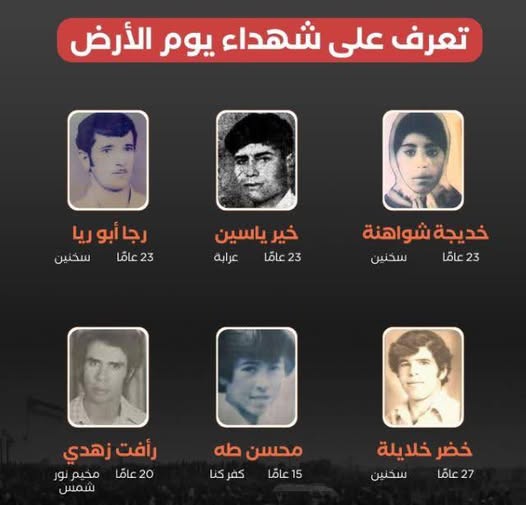
Israeli authorities responded with force, leading to massive protests, particularly in Sakhnin, Arraba, and Deir Hanna, where six Palestinians were killed—four by army gunfire and two by police fire.
