
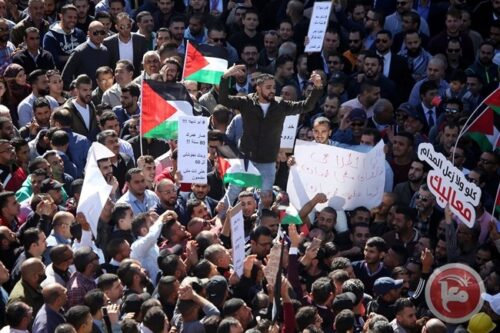
Originally published in Arabic by Ma’an News Agency: The West Bank is quietly unraveling. Beneath the surface of daily life, a slow-burning crisis is taking shape, political immobilization, economic suffocation, and deepening public disillusionment are converging into what experts warn could become an explosive breakdown.
With no political horizon in sight and trust in the Palestinian Authority eroding, the region is inching toward a tipping point.
Israeli pressure is intensifying, and the Palestinian leadership is struggling to respond. The term “silent tsunami,” coined by the head of the Palestinian Studies Forum at Tel Aviv University, captures the scale of transformation underway.
He warned that Israel’s accelerated colonialist expansion is designed to lock in a one-state reality—irreversible and unnegotiable.
Yet amid this seismic shift, Palestinians remain largely silent. That silence, he argues, is not apathy but exhaustion.
Many, especially young people, are losing faith in political solutions and leadership. Some now speak openly of a one-state future, on one condition: equal rights and full citizenship.
A Government on the Brink of Bankruptcy
The Palestinian Authority is facing a financial collapse. Israel continues to withhold clearance revenues—roughly 800 million shekels a month—cutting off more than 65 percent of the government’s income.
With international aid drying up, the PA can no longer pay full salaries. Economic activity has slowed across the board, and foreign trade is faltering.
Unemployment in the West Bank has reached 25 percent. Poverty now affects more than 30 percent of the population.
Even those with jobs—especially public sector workers—are slipping into temporary poverty due to irregular wages.
Hebron, once the industrial heart of the Palestinian economy, is now choked by military roadblocks and iron gates that isolate entire districts and block movement.
Kamel Husseini, a board member of Hebron’s Chamber of Commerce, says the closures are strangling trade.
“The gates and barriers are driving up transport costs, cutting off exports and imports. Businesses are scaling back or shutting down. The impact on the national economy is devastating.”
Industrial output has dropped 15 percent in two years. Market activity is down 10 percent. Farmers and merchants are bearing the brunt of the decline. Husseini calls the crisis a product of Israeli siege, weak financial support, and vanishing investment opportunities. “We need urgent intervention,” he says.
Trust Is Fracturing—And Transparency Is Missing
The public’s trust in the government is wearing thin. Analysts say the problem isn’t just economic—it’s informational. Citizens feel left in the dark. Financial data is scarce. Crisis management plans are vague. The result is confusion, anxiety, and growing resentment.
Professor Abdul-Halim Shawar Tamimi, former deputy head of Hebron’s Chamber of Commerce, says the government must adopt a clear and transparent approach.
“People are fixated on salary percentages and payment dates. That narrow focus is creating widespread panic. We need a roadmap—something concrete that restores confidence.”
Tamimi, a veteran of the business sector, says the economic community is watching closely. “The government announced austerity measures. Now we need to see them implemented. Measurable steps. Real results. That’s how you rebuild trust.”
Occupation Tightens Its Grip
Meanwhile, Israel is tightening its control over Palestinian cities. Iron gates at urban entrances are isolating entire communities.
In Hebron and Bethlehem, movement is restricted. In southern Hebron, so-called “grazing colonialist outposts” are expanding, colonizers are attacking homes and farmland, trying to force families to leave.
Experts Warn: Collapse May Come Suddenly
Economists and political analysts warn that the West Bank’s social and economic fabric is eroding. The pressure is mounting—political fragmentation, financial siege, declining incomes, and fading hope are forming a volatile mix.
The explosion, they say, may not be just political. It could be social. It could be security-related. And it could come without warning.
The West Bank is facing a layered crisis. Stabilizing the situation will require urgent internal reforms and external support.
International and Arab aid must be revived. Transparency must be restored. These are not just policy goals—they are lifelines. Without them, the slow collapse may become a sudden one.
