
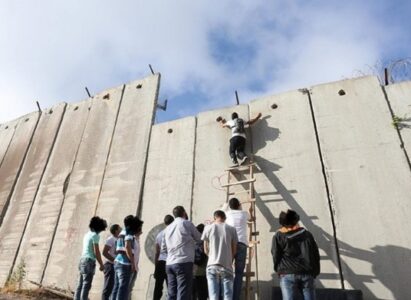
Two Palestinian workers were injured in separate incidents while attempting to cross the Israeli Annexation Wall in the town of ar-Ram, north of occupied Jerusalem, underscoring the daily risks faced by laborers seeking access to employment under Israeli occupation.
On Monday, a 50-year-old Palestinian man sustained moderate injuries after falling from the wall.
According to the Palestinian Red Crescent Society (PRCS), emergency teams provided first aid at the scene before transferring him to Palestine Medical Complex in Ramallah. His condition was described as stable but requiring further medical attention.
The previous day, Israeli soldiers shot a young Palestinian man with live ammunition in the chest and shoulder while he attempted to scale the wall in the al-Bireh neighborhood of ar-Ram. He was also treated by PRCS medics and hospitalized.
These incidents are not isolated. They reflect a broader pattern of violence and systemic neglect targeting Palestinian workers who attempt to cross into the 1948-occupied territories to earn a living.
Since October 2023, the West Bank economy has collapsed under the weight of military closures, permit revocations, and Israel’s withholding of Palestinian tax revenues.
Unemployment has surged, public sector salaries have gone unpaid, and essential services—including education and healthcare—have deteriorated.
The General Federation of Palestinian Trade Unions reports that 96% of businesses have reduced activity, and over 42% have laid off workers.
Before the genocide in Gaza, nearly 390,000 Palestinians held jobs inside Israel. After October 7, 2023, Israel revoked most work permits and sealed crossings, leaving tens of thousands jobless overnight.
With no legal pathways to employment, many workers resort to scaling the 8-meter-high Annexation Wall, often at night, to reach jobs in Israeli cities. They call this pursuit “luqmet al-‘aish”—the struggle for a morsel of bread.
The Annexation Wall, deemed illegal under international law by the International Court of Justice in 2004, has become a militarized barrier of economic coercion.
Injuries from falls, shootings, and beatings are common. In 2025 alone, at least 15 workers have been killed and dozens more wounded while attempting to cross. Many are sole providers for large families, navigating a system that criminalizes survival and punishes poverty.
Human rights organizations continue to demand safe access routes, legal protections for Palestinian laborers, and accountability for Israeli forces involved in these abuses.
