
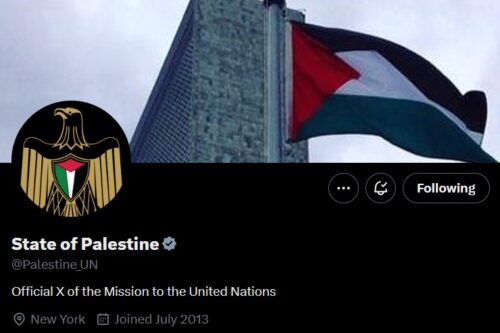
The U.S. State Department has issued a directive barring Palestinian officials and diplomats, especially President Mahmoud Abbas, from attending next month’s United Nations General Assembly in New York.
The decision, outlined in an internal memo circulated Friday, includes the cancellation of all Palestinian visas issued before July 31 and explicitly names Abbas.
This escalation follows newly imposed sanctions targeting both the Palestinian Authority and the Palestine Liberation Organization. U.S. officials claim the measures respond to alleged “violations of American laws concerning the PLO’s obligations and its role in the peace process.”
Secretary of State Marco Rubio stated that the visa revocations aim to “safeguard U.S. national security,” accusing Palestinian leadership of “endorsing violence, pursuing unilateral statehood recognition, and engaging with international legal bodies against Israel.”
While the Palestinian mission to the UN is exempt from these restrictions, the memo offers no clarity on whether other delegation members will be permitted entry.
It also accuses the Palestinian Authority of “inciting hostility, supporting families of individuals involved in armed resistance, and promoting antisemitic rhetoric,” claims widely contested by rights advocates.
President Abbas had planned to deliver a constitutional declaration affirming Palestinian independence during the General Assembly session, scheduled for September 23–27.
The U.S. decision effectively blocks this initiative and marks the first time a host country has fully barred an invited foreign delegation from participating in the UN’s annual gathering.
Legal experts warn that the move violates the 1947 Host Country Agreement, which obligates the United States to grant access to UN headquarters for all invited delegations, regardless of political disputes.
As a non-member observer state since 2012, Palestine holds a recognized legal right to participate in General Assembly proceedings, making the U.S. action a direct breach of its UN obligations.
Despite the legal implications, Washington’s influence within the UN system shifts the issue from a matter of international law to a broader diplomatic standoff.
Analysts note that even adversarial states have historically received entry waivers to attend UN sessions, underscoring the gravity of the current exclusion.
This decision sets a dangerous precedent, politicizing access to the UN and undermining the institution’s neutrality.
It also raises urgent questions about the future of Palestinian representation on the global stage and the erosion of international norms designed to protect diplomatic engagement.
 In a statement, the Palestinian presidency “stressed that this decision stands in clear contradiction to international law and the UN Headquarters Agreement, particularly since the State of Palestine is an observer member of the United Nations.”
It called on the US Administration to reconsider and reverse its decision, affirming Palestine’s full commitment to International Law, UN resolutions and obligations towards peace.
Notably absent from the U.S. memo is any acknowledgment of its own violations or complicity in shielding Israel from accountability.
While Washington moves to penalize Palestinian officials for alleged breaches of U.S. law, it remains silent on Israel’s documented killing of Palestinian-American citizens, including veteran journalist Shireen Abu Akleh, who was shot by Israeli forces in 2022 while clearly identified as press.
Despite international outcry and forensic evidence, the U.S. has failed to pursue justice or demand criminal accountability.
The U.S. refusal to demand justice for her death, and for other Palestinian-American victims, exposes a double standard that enables impunity and reinforces structural violence.
This pattern extends to other cases, such as the deaths of Omar Assad and Saifullah Musallet, both U.S. citizens killed in the occupied West Bank.
The absence of meaningful U.S. action underscores a policy that protects Israeli perpetrators while punishing Palestinian diplomacy.
The memo not only omits reference to these violations but actively deflects from Washington’s role in shielding Israel diplomatically.
While Palestinian officials are punished for diplomatic initiatives, the U.S. continues to provide Israel with political cover in international forums, blocking resolutions, vetoing ceasefire resolutions, and undermining investigations into war crimes.
Simultaneously, the U.S. has escalated arms transfers to Israel throughout its offensive in Gaza, supplying precision-guided munitions, bunker busters, and other lethal aid used in the systematic destruction of civilian infrastructure.
These weapons have been deployed in attacks that killed tens of thousands of Palestinians, including entire families, journalists, and medical personnel.
This complicity not only violates international law but undermines the very principles the UN was founded to uphold.
In related news, The Organization of Islamic Cooperation (OIC) expressed deep regret over the U.S. State Department’s decision to deny entry visas to the Palestinian delegation scheduled to participate in the 80th session of the United Nations General Assembly in New York next month.
The OIC called on the United States government to urgently reconsider what it described as a discriminatory decision that contravenes international law and violates the Headquarters Agreement, an accord the U.S. is legally bound to uphold.
The organization emphasized that Washington must honor its treaty obligations and respect the United Nations’ role as a multilateral platform that guarantees equal representation for all member states and their official delegations.
Furthermore, the OIC urged all international actors, particularly the United Nations, to take immediate action and engage with the relevant U.S. authorities to reverse this exclusionary measure.
Meanwhile, Malaysia has reiterated its demand for the suspension of Israel’s membership in the United Nations and the imposition of sweeping international sanctions, citing the ongoing genocide in Gaza.
Foreign Minister Mohamad Hasan stated that Malaysia had previously raised the issue at the UN General Assembly and will renew the call during the upcoming session.
He asserted that the time has come for the global community to take decisive action, urging all nations to implement sanctions against Israel.
Hasan stressed that such measures must include halting the flow of weapons to the occupying power, describing arms restrictions as vital to limiting its capacity for destruction.
He underscored that most of the international community has clearly opposed Israel’s plans to seize and demolish Gaza, framing the moment as a critical test of global will to confront impunity and uphold justice.
