
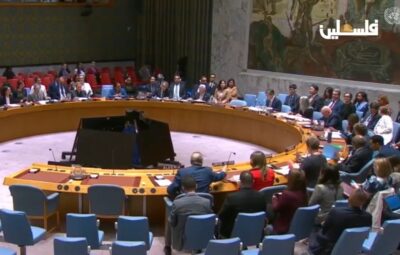
In a historic session marking the 10,000th meeting of the United Nations Security Council, the United States cast its veto against a resolution calling for an immediate, unconditional, and permanent ceasefire in Gaza. Held Thursday evening in New York, the vote saw 14 of the Council’s 15 members support the draft—leaving Washington isolated in its opposition, yet the determining factor.
The resolution, introduced by the Council’s ten elected members—including Pakistan, Panama, Algeria, South Korea, Denmark, Slovenia, Sierra Leone, Somalia, Guyana, and Greece—called for a sustained ceasefire, the lifting of all restrictions on humanitarian aid, and the restoration of essential services in Gaza.
It emphasized the urgent need for safe, unhindered access for UN agencies and humanitarian partners to reach the 2.1 million Palestinians affected by the ongoing genocide, in accordance with international humanitarian law and core principles of neutrality and impartiality.
Denmark’s UN Ambassador Christina Markus Lassen, speaking on behalf of the sponsors, underscored the gravity of the crisis: “Famine has been confirmed in Gaza—not projected, not declared, confirmed,” she said. “This catastrophic situation, this humanitarian and human failure, has compelled us to act today.”
South Korea’s ambassador, presiding over the Council for September, highlighted the symbolic weight of the meeting, which coincided with the UN’s 80th anniversary and the eve of the General Assembly’s high-level week. He urged members to honor these milestones by upholding their mandate to protect peace and security.
Defending the veto, U.S. Deputy Special Envoy Morgan Ortagus argued that the resolution failed to condemn Hamas and ignored Israel’s right to self-defense.
She claimed the text “wrongly legitimizes false narratives benefiting Hamas” and criticized other Council members for disregarding U.S. concerns about the resolution’s framing.
Palestinian Ambassador Riyad Mansour condemned the veto as “deeply regrettable,” asserting that it blocked the Council from fulfilling its duty to protect civilians amid the genocide.
Algerian Ambassador Amar Bendjama echoed the sentiment, apologizing to Palestinians and lamenting the international community’s failure to halt the suffering: “Forgive us,” he said. “The world speaks of rights but denies them to Palestinians.”
The vote came as Israeli forces intensified their ground offensive in Gaza City, escalating a genocide that began on October 7, 2023. Since then, more than 65,000 Palestinians have been killed—including thousands of children, medical workers, and journalists—with over 165,000 injured. Many remain trapped under rubble, unreachable by emergency crews.
This marks the sixth U.S. veto of ceasefire-related resolutions since the onset of the genocide, reinforcing Washington’s diplomatic shield for Israel despite mounting global condemnation.
The decision also precedes the UN General Assembly summit, where several U.S. allies are expected to formally recognize Palestinian statehood, a move opposed by both Israel and the United States.
The veto has reignited debate over the integrity of international justice. With overwhelming support for the resolution, the lone dissenting vote from Washington halted a measure that could have delivered critical aid and protection to civilians.
Mansour warned that the Council’s credibility had been compromised, and that its failure to act in the face of mass suffering exposed a dangerous paralysis.
In this context, justice is not a theoretical ideal—it is the difference between survival and collapse. It determines whether food reaches starving families or is blocked at borders. The veto did more than reject a resolution; it severed a lifeline. It revealed how strategic interests can override humanitarian imperatives, even when the cost is measured in tens of thousands of lives.
