
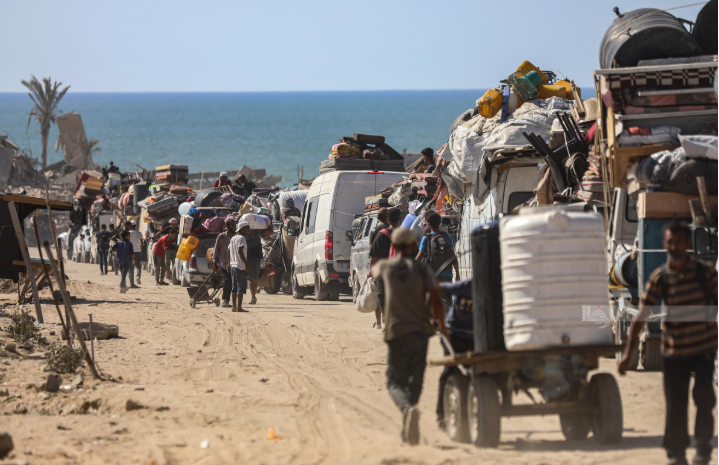
The spokeswoman for the United Nations Children’s Fund (UNICEF), Tess Ingram said: The forced mass displacement of families is a “deadly threat to the most vulnerable groups”, as bombs continue to fall on Gaza as part of the escalation of the Israeli aggression on the city.
Speaking from the southern Gaza Strip to reporters in Geneva, a UNICEF spokeswoman said Palestinian families and their hungry children were being pushed south from one “hell” to another.
She added: “It is inhumane to expect nearly half a million children, who have suffered violence and psychological trauma as a result of more than 700 days of continuous conflict, to flee one hell and end up in another.”.
Lack of good options
According to the United Nations Office for the Coordination of Humanitarian Affairs (OCHA), partners monitoring population movement in Gaza over the past few days counted nearly 70,000 displaced people heading south, and about 150,000 over the past month.
Ingram said the only road available – Rashid Street – was “very busy” when she visited yesterday, Monday.
The UNICEF spokeswoman described her meeting with a mother who walked for more than six hours from Gaza City to the south with her five children, “all dirty, thirsty, and starving”, two of whom were barefoot. She added that these families are being pushed into a “so-called humanitarian zone” that includes Al Mawasi and the surrounding areas.
Ingram described their destination as “a sea of temporary tents and human despair” where services are insufficient to support the hundreds of thousands already living there.
She recalled that the Al-Mawasi area was subjected to an Israeli attack about two weeks ago, in which eight children were killed while standing in line for water. The youngest victim was three years old.
She stressed that “people don’t really have a good choice,” to the point that some families “come and look and go back to Gaza City,” when they realize there is “no safe place” to go.
Worsening malnutrition
She said that child malnutrition in Gaza is worsening, noting that according to UNICEF estimates, approximately 26,000 children in the Strip currently need treatment for acute malnutrition, including more than 10,000 children in Gaza City alone, where famine was confirmed late last month.
Ingram reported that more feeding centers in Gaza City were forced to close this week due to “evacuation orders” and Israeli military escalation, “depriving children of a third of the remaining treatment centers that could save their lives”.
She stressed that humanitarian workers are still in their positions and continue to respond to the crisis, “but it becomes more difficult with every bombing and every prevention.”
Possible ethnic cleansing
For its part, the United Nations Human Rights Office in the Occupied Palestinian Territory reiterated its call on the Israeli occupation forces to “immediately stop the barbaric destruction of Gaza City, which appears to be aimed at bringing about a permanent demographic transformation, which amounts to ethnic cleansing”.
In a statement, the office confirmed that the ongoing (Israeli) bombing of residential buildings in the city “destroys the last viable element of infrastructure, undermining any possibility of civilian survival.”
“Many Palestinians are being killed in the intense Israeli bombardment of Gaza City that began on September 11, and the vast majority of them appear to be civilians,” he said. However, he added that it is difficult to assess the total number of victims resulting from attacks on buildings “used as shelters, as many bodies remain under the rubble.”
The office also noted that Israeli occupation forces closed the vital Zikim crossing in northern Gaza, completely halting the flow of humanitarian aid, “which could exacerbate famine in the region”.
As mass displacement to the southern Gaza Strip increases, overcrowding worsens, and protection-related incidents rise, the office stressed that the occupation authorities continue to impose restrictions on the large-scale entry of tents and other materials into the Gaza Strip, which is “the most urgent need to ensure dignity and safety during displacement”.
The Human Rights Office said that the behavior of the Israeli occupation forces in Gaza raises concerns about the commission of “a whole range of crimes under international law,” and therefore the international community must take concrete action “to stop this unjustified destruction, killing, and displacement”.
Destruction of the education sector
Regarding education, the Human Rights Office stressed that depriving Palestinian children of education for three consecutive school years, along with the killing of thousands of students and the destruction of educational infrastructure, “represents a humanitarian emergency and a serious violation of international law”.
According to the Ministry of Education and Higher Education, more than 17,237 school students and 1,271 university students have been killed, along with 967 educational staff since the beginning of the Israeli war of extermination on October 7, while the United Nations found that 97% of the sector’s schools were damaged by the war.
In the occupied West Bank, including East Jerusalem, the United Nations documented more than 2,000 incidents affecting schools during the 2024-2025 school year-disrupting the learning of 84,749 students – including live ammunition and tear gas fired by occupation forces near schools and demolition or work stoppage orders.
The office stressed that international humanitarian law provides clear protection for education during armed conflict, and stressed that repeated attacks on schools and the killing of students and teachers “may amount to war crimes”.
