
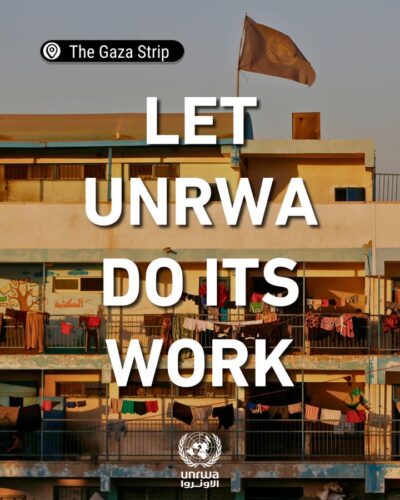
The United Nations Relief and Works Agency for Palestine Refugees (UNRWA) announced that Israeli occupation authorities are holding back nearly 6,000 trucks loaded with food and relief supplies, enough to sustain Gaza for three months. The shipments also include hundreds of thousands of tents and blankets intended for 1.3 million displaced Palestinians.
UNRWA spokesperson Adnan Abu Hasna explained that while the number of trucks entering Gaza has “formally increased” compared to the period before the ceasefire, the current flow remains far below the massive humanitarian needs after two years of war and blockade.
He stressed that Israel continues to block the entry of hundreds of vital items, including medical equipment, spare parts for desalination and sewage plants, sanitation supplies, and basic foodstuffs.
Abu Hasna added that the majority of Gaza’s population has lost almost all purchasing power, leaving total dependence on aid as the only remaining lifeline.
Humanitarian organizations have submitted requests to bring in essential materials to keep basic services running, but Israel has rejected most of these requests, allowing in only minimal food supplies and limited medicines.
Recent reports highlight the scale of the crisis. Only about 170 trucks per day are entering Gaza, compared to the 500–600 trucks daily minimum required to meet basic needs.
Malnutrition rates have soared, with nine out of ten families now dependent on aid for survival. UNRWA clinics treat 15,000 patients daily, but fuel shortages have crippled municipal services, halting waste collection, water pumping, and emergency rescue operations.
Heavy rainfall in late November worsened conditions in displacement camps, where flooding mixed with sewage and tens of thousands of tents collapsed.
UNRWA shelters currently house 80,000 displaced people, while 44,000 children attend makeshift classes in overcrowded temporary learning spaces. Since the war began, UNRWA has lost 380 staff members, and 90 percent of its facilities have been damaged.
The agency also faces a $200 million deficit, compounded by the suspension of U.S. funding. Despite these challenges, UNRWA continues to warn that without immediate access to the blocked trucks and essential supplies, Gaza risks sliding into famine, disease outbreaks, and total collapse of basic services.
On Monday, the Israeli army killed one Palestinian and injured many in a series of escalation and violations of the “ceasefire agreement,” in place since October 10.
Since the “ceasefire” began on October 11, 2025, the total stands at 356 slain and 908 wounded, with 607 bodies recovered.
Since October 7, 2023, the overall toll of Israel’s assault on Gaza has reached 70,103 martyrs and 170,985 wounded, the majority of them children and women.
