

Illegal paramilitary Israeli colonizers burned vehicles, a home under construction, and an agricultural room, assaulted a Palestinian man, and held schoolchildren across the occupied West Bank overnight and on Tuesday, local sources and WAFA News Agency said. Near occupied Jerusalem, local sources said Israeli soldiers fired tear gas and stun grenades at olive farmers, while colonizers attacked them under military protection.
In the Nablus governorate in the northern West Bank, colonizers invaded the northern part of Majdal Bani Fadel village, south of Nablus city, at dawn Tuesday and set fire to two vehicles parked outside residents’ homes. Local sources identified the owners as Wadea’ Zainuddin and Ala’ Zainuddin.
In Burqa, northwest of Nablus city, colonizers severely beat a 60-year-old Palestinian man on Tuesday. Amid Ahmad, director of the Palestinian Red Crescent Society’s ambulance and emergency center in Nablus, said ambulance crews treated the injured man and transported him to a hospital.
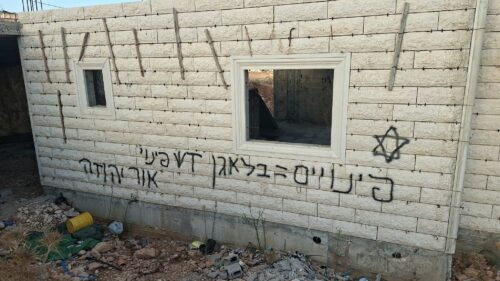 In Wadi ar-Rakhim in Yatta, south of Hebron in the southern West Bank, colonizers burned two vehicles, an agricultural room, and a home under construction on Tuesday, according to local anti-colonization activist Osama Makhamra. The fire burned belongings inside the unfinished home, and colonizers painted racist slogans on its walls.
Makhamra said colonizers, under the protection of Israeli forces, blocked the route of schoolchildren from Khirbet Asfi in Masafer Yatta and held them for about an hour as they headed to schools in al-Majaz and al-Fakhit.
In al-Markaz village, also in Masafer Yatta, colonizers wearing military uniforms broke into a resident’s home, damaged surveillance cameras, and punctured water tanks, Makhamra added. They also broke into a cave used by the same resident as a dwelling and vandalized its contents.
In Beit Anan, northwest of occupied Jerusalem, several Palestinians suffered from tear gas inhalation on Tuesday morning after Israeli soldiers fired tear gas and stun grenades at dozens of residents trying to reach their olive groves in the al-Salaqat and al-Bureij areas on the town’s outskirts. Local sources said soldiers prevented them from harvesting, while colonizers in the area attacked farmers and blocked access to their land.
The incident was part of continuing attacks on Palestinian farmers during the olive harvest season, including obstruction of access to agricultural land, physical assaults, damage to trees, and theft of harvested olives.
Overnight, colonizers also attacked greenhouses belonging to Palestinian farmers near Bardala and Kardala in the northern Jordan Valley, in the Tubas governorate in the northeastern West Bank. Human rights activist Aref Daraghma reported the attacks but said information about the extent of the damage was not available.
Human rights activists say repeated attacks on homes, agricultural structures, and other property in the northern Jordan Valley, alongside restrictions on residents and their livelihoods, make it increasingly difficult for Palestinian communities to remain on their land and contribute to their displacement.
In a separate development reported Tuesday, WAFA News Agency said Israeli authorities issued a military order placing 26.473 dunams of land in Deir Nitham, Umm Safa, and Atara, northwest of Ramallah in the central West Bank, under military possession for a road designated the “Ateret–Neve Tzuf emergency route,” citing military purposes.
The Wall & Colonization Resistance Commission said the order was issued on October 28 and remains effective through the end of 2028. It grants the military commander exclusive possession of the designated land but does not itself transfer ownership.
The commission said the route could strengthen connections between colonies and outposts around Ateret and Halamish, also known as Neve Tzuf, facilitate colonizer movement between Palestinian towns, and potentially impose further restrictions on landowners’ access to adjoining plots, depending on implementation arrangements.
In a report released Monday, The Wall & Colonization Resistance Commission said colonizers carried out 1,369 attacks in October, an increase of 111.6 percent from the 647 recorded in September.
Of the October colonizer attacks, 393 were recorded in the Ramallah and al-Bireh governorate in the central West Bank, the highest governorate total, followed by Nablus with 353. Separately, the commission recorded 3,133 attacks by Israeli forces and colonizers combined during October, targeting Palestinians, their land, and their property.
