

Published In Arabic On WAFA, By Rami Samara: In the early hours of dawn, 58-year-old Fidda Mohammad Na’san awoke to the piercing cries of an international solidarity activist staying in the adjoining room of her home in al-Khalayel, a hamlet of al-Mughayyir village east of Ramallah in the occupied West Bank’s central part.
As she stepped out to understand the commotion, Fidda witnessed two activists being dragged violently.
Within moments, a group of illegal paramilitary Israeli colonizers stormed her home. One struck her with a stone on the forehead, knocking her unconscious. When she tried to rise, they beat her with sticks, threw her to the ground, and before leaving, issued a chilling ultimatum:
“You have two days to leave. Today you survived. Next time, you won’t.”
Brutality Inside the Home
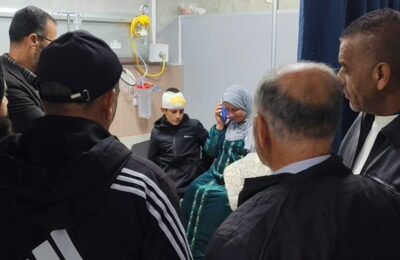
Fidda recalls the terror of facing five colonizers from a larger group that had invaded the house: “Their numbers made it seem certain none of us would survive. By sheer luck, it was only stones and sticks.”
She sustained a head wound and bruises across her body. Her 13-year-old grandson, Rezeq Humam Abu Na’im, was struck on the head with a flashlight, leaving him bleeding.
Rezeq recounts waking to screams and blood: his grandmother collapsed, an activist clutching her bleeding arm, and colonizers advancing toward him.
One attempted to attack him directly, but an activist intervened. As Rezeq fled to seek help from his father, another colonizer intercepted him and smashed the flashlight against his skull.
A Family Under Siege
The Abu Na’im family had endured harassment before, but never an assault of such ferocity and with such a clear intent: forced displacement.
For two years, colonizers have carried out near-daily attacks — vandalizing property, destroying crops, and encircling the home.
Fidda explains: “This time they came inside, believing our blood would frighten us into leaving within two days.”
Coordinated Terror
According to Marzouq Abu Na’im, deputy head of al-Mughayyir Village Council, the threat must be taken seriously. It was time-bound, carried out with the knowledge of the Israeli army, and executed by a new group of colonizers unfamiliar to locals. He suspects they were mobilized from multiple outposts around the village.
 The attack followed hours of aerial surveillance by a drone, while Israeli forces erected a military roadblock on the road to al-Khalayel — preventing villagers from intervening and granting colonizers the time needed to complete their assault.
Marzouq warns that if the family is forced out, colonizers will seize over 2,000 dunams of land. He stresses that solidarity is essential: “Supporting Rezeq’s family is not just about protecting two dunams they own. Their presence is a barrier against colonization spreading deeper into al-Mughayyir.”
A Pattern of Expulsion
Abdullah Abu Rahma, Director of Popular Action and Resilience at the Wall & Colonization Resistance Commission, underscores that this attack is part of a broader strategy.
He notes that colonizer militias have already used similar threats to expel nearly 40 Bedouin communities across the West Bank in the past two years.
Abu Rahma connects the violence to the extremist doctrine of Israeli Finance Minister Bezalel Smotrich, who openly declared: “The Palestinian must either leave, die, or serve as a slave.”
This incident is not an isolated act of violence, but a deliberate campaign of terror designed to uproot Palestinians from their land.
The Abu Na’im family’s ordeal illustrates the systematic nature of colonizer attacks — coordinated with military oversight, emboldened by extremist ideology, and aimed at erasing Palestinian presence in the occupied West Bank.
