
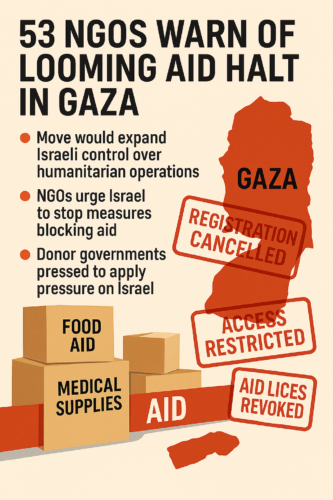
- Groups say the measures would set a dangerous precedent by tightening Israeli control over humanitarian operations
- NGOs call on Israel to immediately stop actions that obstruct aid delivery
- Donor governments urged to pressure Israel to reverse course
Dozens of international humanitarian organizations working in the occupied Palestinian territory cautioned that Israel’s latest registration requirements could effectively shut down international NGO operations at a moment of severe and widespread civilian need, despite the ceasefire in Gaza.
In a statement released Friday, the groups said 37 international NGOs were formally notified that their registration would end on 31 December 2025, triggering a 60‑day period after which they would be compelled to halt all activities in Gaza and the West Bank, including East Jerusalem.
The organizations underscored that international NGOs form the backbone of the humanitarian response, partnering with the United Nations and Palestinian civil society to deliver large‑scale, life‑saving assistance.
The UN, the Humanitarian Country Team, and donor governments have repeatedly stressed that these organizations are essential to both humanitarian and development efforts and have urged Israel to reverse the decision.
Humanitarian needs remain extraordinarily high. In Gaza, one in four families survives on a single meal per day, while winter storms have displaced tens of thousands of people, leaving 1.3 million in urgent need of shelter.
According to the statement, international NGOs currently:
- provide over half of all food assistance in Gaza,
- operate or support 60% of field hospitals,
- carry out nearly three‑quarters of shelter and non‑food‑item programs,
- deliver all treatment services for children suffering from severe acute malnutrition.
Excluding these organizations, they warned, would result in health‑facility closures, halted food distribution, collapsed shelter supply chains, and the loss of critical, life‑saving services.
West Bank: rising violence and shrinking humanitarian access
The groups reported that ongoing Israeli military incursions and violence by Israeli paramilitary colonizers continue to displace communities across the West Bank.
Additional restrictions on international NGOs, they said, would sharply curtail the reach and continuity of life‑saving assistance at a pivotal time.
They also criticized recent attempts to assess the impact of deregistration using selective metrics, arguing that such indicators “do not reflect how humanitarian aid is actually delivered.”
Real humanitarian access, they said, must be measured by whether civilians receive appropriate assistance, in the right location, at the right moment.
International NGOs operate under strict donor‑imposed compliance systems and due‑diligence requirements aligned with global standards.
More than 500 humanitarian workers have been killed since 7 October 2023, the groups noted.
They added that NGOs cannot share sensitive personal data of local staff with any party to the conflict, as doing so would violate humanitarian principles, duty‑of‑care obligations, and international data‑protection norms.
Misleading claims, they warned, undermine humanitarian organizations, endanger staff, and obstruct aid delivery.
“A political decision with predictable consequences”
The organizations emphasized that the deregistration move is not a bureaucratic or administrative matter, but a deliberate political action with foreseeable humanitarian fallout.
If implemented, they said, Israel would be directly blocking large‑scale humanitarian assistance. Humanitarian access, they stressed, is a legal requirement under international humanitarian law, not a discretionary policy choice.
They warned that the measures would create a dangerous precedent, extending Israeli control over humanitarian operations in the occupied Palestinian territory in ways that contradict internationally recognized legal frameworks governing the area and the responsibilities of the Palestinian Authority.
The groups called on the Israeli government to immediately halt the deregistration process and end actions that impede humanitarian work.
They also urged donor governments to use every available diplomatic and financial tool to ensure the measures are suspended and reversed, stressing the need to safeguard independent, principled humanitarian operations so civilians can receive urgently needed aid.
Sector‑by‑sector consequences
- NGOs operate or support around 60% of Gaza’s field hospitals. Deregistration would shut down nearly one‑third of all health facilities.
- NGOs delivered more than half of all food assistance in 2024, including most cooked‑meal distribution points.
- NGOs carry out about 75% of shelter and non‑food‑item activities, with 600,000 shelter items currently in their supply pipelines.
- NGOs provide 42% of water, sanitation, and hygiene services, including prevention and response to acute watery diarrhea.
- NGOs support 100% of Gaza’s therapeutic feeding centers for children with severe acute malnutrition.
- NGOs supply over half of all explosives‑hazard‑removal funding; exclusion would reduce capacity by up to 100%.
- NGOs operate or support around 30% of emergency education programs, which already reach only a limited share of school‑age children.
The organizations reiterated that humanitarian agencies cannot share sensitive personal data of local staff or their families — a direct response to Israel’s demand for personal information on Palestinian employees for “security screening.”
Signatory organizations:
ACTED
Action Against Hunger
Action for Humanity
ActionAid
American Friends Service Committee
Amnesty International
ARCS – Italian Association for Cooperation and Solidarity
CADUS
Campaign for the Children of Palestine (Japan)
CARE Canada
CARE International UK
Children Are Not Numbers
Churches for Middle East Peace
Cooperation South–South
Council for Arab British Understanding
DanChurchAid
Danish Refugee Council
Diakonia
Educo
EMERGENCY
Terre des Hommes Foundation – Lausanne
GVC/WeWorld
HEKS/EPER – Swiss Church Aid
Human Rights Solidarity
Humanity & Inclusion (Handicap International)
Interpal
Islamic Relief
Japan International Volunteer Center (JVC)
Médecins du Monde – Switzerland
Médecins du Monde – France
Médecins Sans Frontières
Medical Aid for Palestinians
medico international
Médecins du Monde – Spain
Mennonite Central Committee
Middle East Children’s Alliance
NORWAC – Norwegian Aid Committee
Norwegian Church Aid
Norwegian People’s Aid
Norwegian Refugee Council
Oxfam
Pax Christi USA
Peace Winds Japan
Première Urgence Internationale
Quakers in Britain
Solidarités International
Terre des Hommes – Italy
Bridge to…
United Against Inhumanity
Vento di Terra
War Child Alliance
War on Want
