
When Philippe Lazzarini, the Commissioner‑General of UNRWA, warned this week that Palestinian refugee education has come under “intensifying attacks,” he was not speaking in abstractions. His statement reflects a crisis that has been unfolding in slow motion for years, accelerating sharply with the devastation in Gaza.
What was once one of the most stable and structured school systems in the region has been reduced to a patchwork of temporary shelters, digital worksheets, and children trying to memorize the alphabet in overcrowded rooms lit by battery lamps.
More than 600,000 children in Gaza have been out of formal classrooms for over two years, according to UNRWA. They are growing up in a landscape where playgrounds have been replaced by rubble, and where the sound of chalk on a blackboard has been overtaken by the noise of drones and generators.
A School System That Once Anchored Daily Life
Before the destruction, UNRWA’s schools formed the backbone of Gaza’s education network. They operated on a double‑shift system to accommodate high population density, serving more than 280,000 students. Teachers were trained, curricula were standardized, and classrooms, though crowded, offered predictability.
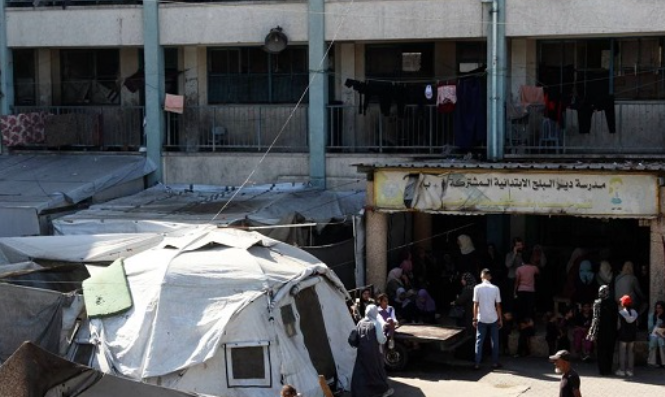
Today, more than 70% of UNRWA schools have been damaged or destroyed. Many of the remaining buildings are being used as shelters for displaced families, leaving no space for regular classes. In some locations, the classrooms still standing are filled with mattresses instead of desks.
“Education used to be the one thing families could count on,” said a senior UNRWA education officer coordinating emergency programs from Gaza’s south. “Now we’re trying to rebuild a system without buildings, without materials, and with children who are carrying trauma no child should ever experience.”
Children Learning in the Shadows of Trauma
The psychological toll is staggering. Humanitarian workers describe children who flinch at loud sounds, struggle to sleep, stop speaking, or cling to their parents with a fear that did not exist before the war. Teachers report that many students cannot focus long enough to complete a simple exercise.
“Some children don’t remember how to write their own names,” said a Gaza‑based counselor working with displaced families. “Others refuse to sit near windows because they associate them with explosions.”
The absence of school is not just an educational setback—it is a rupture in the social fabric. Schools in Gaza have long served as community centers, safe spaces, and the primary point of contact between families and humanitarian services. Their loss has left a vacuum that no temporary program can fully fill.
Temporary Learning Spaces: A Lifeline With Limits
UNRWA has established 65,000 seats in temporary learning spaces, often tents or makeshift structures assembled in courtyards and empty lots. These spaces provide basic literacy and numeracy lessons, along with psychosocial support. But they are overwhelmed.
In many locations, a single tent holds more than 60 children. Teachers rotate between groups, trying to maintain order while navigating shortages of textbooks, pencils, and even chairs.
Another 300,000 children rely on digital learning, accessing worksheets and short lessons through mobile phones when electricity and internet connections allow. But digital access is uneven. Families often share a single device among several children, and power outages can last for days.
“Digital learning is a bridge,” Lazzarini said in his statement. “But it cannot replace the structure and safety of a real classroom.”
A Crisis Deepened by Funding Cuts
UNRWA’s ability to respond is constrained by a severe funding crisis. Several major donors froze or reduced contributions in 2024, leaving the agency scrambling to maintain even its most basic services. Education, which accounts for a sizable portion of UNRWA’s mandate, has been hit especially hard.
The agency has warned repeatedly that without stable funding, it cannot guarantee the continuity of emergency schooling programs. Teachers are working under extraordinary pressure, often without knowing whether their salaries will be paid.
The Long‑Term Consequences
Education experts caution that Gaza is facing the prospect of a “lost generation”—children who will enter adulthood without the foundational skills needed for employment, civic participation, or emotional stability. The economic implications are profound: a population without education is a population locked out of future recovery.
But the consequences are not only economic. Schooling shapes identity, community, and the sense of possibility. Without it, children grow up in a world defined by survival rather than aspiration.
A Call for Protection and Accountability
UNRWA continues to call for the protection of schools and educational facilities under international law, as well as sustained humanitarian access and the restoration of funding. But the agency also stresses that education cannot be rebuilt in isolation. It requires stability, infrastructure, and a political environment in which children can learn without fear.
For now, Gaza’s children wait, some in tents, some in shelters, some scrolling through lessons on cracked phone screens, hoping for a return to classrooms that no longer exist.
