
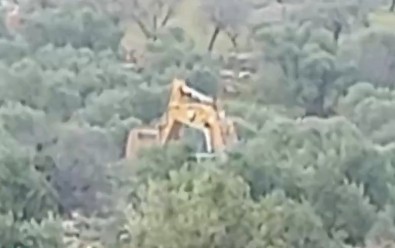
Israeli occupation forces uprooted trees on Tuesday in the village of Kafr Malik, northeast of Ramallah, in the occupied West Bank’s central part.
Local sources reported that the forces invaded the village, accompanied by a military bulldozer, which began leveling land and uprooting trees across an area estimated at 35 dunams.
The invasion and destruction followed a military order issued about a week ago, instructing the removal of a tree layer, including olive trees, covering the same area of village land.
More than ten families stand to be affected by the measure, which they described as an arbitrary act targeting agricultural land and undermining the rights of its Palestinian owners.
In a separate development, Israeli forces intensified military restrictions on Tuesday across several areas north of Ramallah.
Local sources reported that soldiers set up a military roadblock at the entrance to Ein Siniya, disrupting movement in and out of the city.
Additional restrictions were imposed at the entrance to Turmus Ayya, where Israeli forces installed another roadblock, obstructing the entry and exit of residents and tightening controls on movement from the town.
A further roadblock was established on the road between Silwad and Yabrud, where vehicles were stopped and searched, causing significant delays for commuters.
Kafr Malik and the nearby areas have long faced increasing pressure from Israeli forces and nearby colonialist outposts.
Much of the village’s land falls within Area C, where Israel maintains full control, leaving the community vulnerable to land seizures, demolition orders, and agricultural destruction.
Over recent years, residents have endured repeated incursions, restrictions on access to farmland, and a series of military orders targeting privately owned agricultural plots.
Agriculture, particularly olive cultivation, forms the backbone of the village’s economy, supporting dozens of families.
However, ongoing land‑clearing operations, road closures, and the expansion of surrounding colony infrastructure have steadily reduced the space available for cultivation. Similar patterns have been documented in neighboring communities such as Al‑Mughayyer and Deir Jarir, where tree‑uprooting, bulldozing, and the blocking of agricultural roads have become increasingly common.
These measures form part of a broader trend aimed at reshaping control over the rural areas east of Ramallah, gradually limiting Palestinian presence while facilitating the expansion of settlement outposts across the region.
