
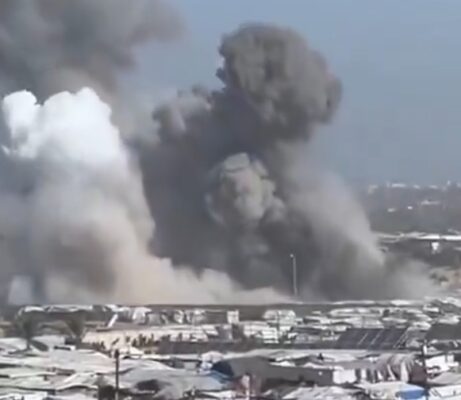
Israeli airstrikes across the Gaza Strip on Saturday killed 31 Palestinians, including children, and wounded dozens more, the Palestinian Ministry of Health confirmed. The Ministry reported that seven of the fatalities were recorded in the southern Gaza Strip and twenty‑four in the north, with hospitals receiving casualties throughout the day as bombardment continued without pause.
Airstrikes struck the Sheikh Radwan and Nasr neighborhoods in Gaza City, hitting residential buildings and family homes.
In the southern Gaza Strip, Israeli warplanes targeted the makeshift tents of displaced families in the al‑Mawasi area west of Khan Younis, causing mass casualties among civilians who had already fled earlier fighting.
Israeli naval vessels also opened fire off the coast of al‑Sudaniya northwest of Gaza City, while Israeli armored units fired intensively east of Gaza City and east of the al‑Bureij refugee camp in the central Gaza Strip.
In addition, medical teams in the northern Gaza Strip confirmed that a Palestinian man was killed and others wounded by Israeli gunfire in Jabalia, in northern Gaza.
The Israeli military said it had targeted four Hamas and Islamic Jihad figures across the Strip, framing the attacks as a response to what it described as “violations of the ceasefire agreement.”
The army added that the current wave of airstrikes would continue, citing what it called “serious incidents” in recent days.
Al‑Jazeera’s correspondent reported that Israeli forces carried out controlled demolitions of residential buildings east of Khan Younis, continuing a pattern of destruction that has reshaped entire neighborhoods since the start of the war.
Humanitarian agencies warned that the renewed bombardment is compounding an already catastrophic situation for civilians.
The UN Office for the Coordination of Humanitarian Affairs (OCHA) said the strikes “raise serious concerns about continued civilian deaths,” noting that winter storms and Israeli restrictions on essential supplies have left hundreds of thousands of displaced Palestinians exposed to life‑threatening cold.
Humanitarian monitors have documented at least eleven child deaths from hypothermia in recent days.
OCHA added that infectious diseases linked to overcrowding, inadequate shelter, and contaminated water continue to overwhelm Gaza’s fragile health system.
UNRWA also said that the conditions for displaced families remain “beyond the limits of human endurance,” with shelters operating at several times their intended capacity and basic services collapsing under the strain of prolonged displacement, winter weather, and ongoing military operations.
Hospitals are functioning with minimal fuel, limited medical supplies, and reduced staff, while water and sanitation systems have largely collapsed, contributing to outbreaks of respiratory infections, diarrhea, and skin diseases.
Amnesty International and Human Rights Watch reiterated concerns about the scale of destruction in civilian areas, calling for independent investigations into strikes on residential neighborhoods, displacement camps, and medical facilities.
UN Special Rapporteurs warned that the combination of bombardment, mass displacement, and restricted humanitarian access may constitute grave violations of international humanitarian law.
Meanwhile, Israeli media reported that the Rafah crossing with Egypt is expected to open on Sunday for a limited pilot phase, with regular movement of travelers beginning Monday.
Channel 15 said the initial plan allows 150 Gaza residents to exit the Strip daily and permits 50 to enter, while foreign journalists will not be allowed to enter Gaza at this stage.
The crossing will be operated by Palestinian staff from Gaza under European Union supervision, while Israel will remotely control a turnstile gate on the Gaza side to block individuals it does not approve for departure. Israeli authorities will also verify the names of all departing passengers.
Although Israeli personnel will not be physically present at the crossing, the remote‑control mechanism effectively grants Israel the ability to prevent specific individuals from leaving.
Entry into Gaza from Egypt will be limited to pre‑approved residents. Those entering will be transported by bus to an Israeli inspection point for identity verification and physical screening.
Israeli media described the process as a measure to allegedly prevent the entry of weapons or unauthorized equipment, framing it as part of a broader transition into what officials have called the second phase of the Trump plan.
The Palestinian Ministry of Health in Gaza also issued its updated casualty figures, stating that since the ceasefire announced on October 11, 2025, the cumulative toll has risen to 509 Palestinians killed, 1,405 wounded, and 715 bodies recovered.
The overall casualty count since October 7, 2023, has reached 71,769 Palestinians killed and 171,483 wounded.
The Ministry noted that 85 newly verified fatalities were added to the cumulative total after their documentation was completed and approved by the official committee responsible for certifying deaths between January 23 and 30, 2026.
