
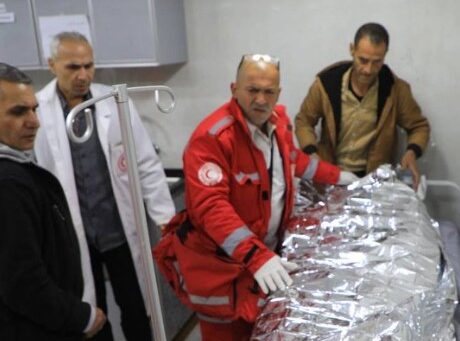
Israeli occupation forces killed three Palestinians in separate incidents, and one succumbed to his wounds, on Thursday, while patients returning through the Rafah crossing reported harsh treatment and prolonged delays imposed by the Israeli army. The limited and inconsistent reopening of the crossing has left critically ill Palestinians stranded amid the near‑total collapse of Gaza’s health system.
Update: On Thursday evening, medical sources said a Palestinian, Ahmad Bakr, succumbed to serious wounds he suffered, last Friday, when the Israeli army bombarded tents of displaced families in Khan Younis.
Medical sources said soldiers fatally shot Baha’ Mohammad al‑Fajem on Thursday morning in the town of Bani Suheila, east of Khan Younis in southern Gaza. The sources confirmed that al‑Fajem was struck by live fire during an Israeli military invasion of the area.
In a separate development, the Prisoners’ Information Office announced the death of Basel al‑Haimouni, a former political prisoner from Hebron who was exiled by Israel to Gaza in 2011. Al‑Haimouni succumbed to wounds sustained in an Israeli airstrike on Wednesday while he was being treated at al‑Saraya Hospital.
Medical sources also reported the death of Rami Ibrahim Abu Qershein, who succumbed to wounds he sustained several months ago in an Israeli bombing of Khan Younis.
The Israeli army continues its violations in the Gaza Strip, bombing and firing live rounds at several areas of the devastated region, especially in Deir al‑Balah, multiple neighborhoods of Gaza City, and parts of central Gaza and Khan Younis.
Earlier in the day, an Al Jazeera correspondent reported that 25 Palestinians returned to Gaza through the Rafah crossing after receiving medical treatment abroad. The Palestinians reached Nasser Medical Complex more than 20 hours after departing the Egyptian city of al‑Arish, many of them visibly exhausted.
25 Palestinian returnees arrived in the Gaza Strip on Wednesday via the Rafah Crossing. pic.twitter.com/LURYyBXncP
— Quds News Network (@QudsNen) February 5, 2026
Returning patients said they were subjected to interrogation, insults, and harassment by Israeli forces at the Rafah crossing on the Palestinian side, and again along Salahuddin Street between Rafah and Khan Younis.
Israeli authorities, meanwhile, sent 26 patients and companions back into Gaza and allowed only 20 patients to leave, offering no explanation for the restrictions. This marked the third consecutive day of limited operations at the crossing.
On Wednesday, the Israeli army abruptly canceled travel coordination for the third group of patients and wounded individuals, just two days after Rafah was partially reopened. The cancellation stranded dozens of critically ill Palestinians who had been preparing to leave for treatment abroad, despite the near‑total collapse of Gaza’s medical infrastructure.
The Rafah crossing with Egypt resumed limited operations on February 2, its first partial reopening in nearly two years. Under the agreement, 50 Palestinians were expected to enter Gaza on the first day, while 50 patients, each accompanied by two relatives, were expected to travel to Egypt. Instead, only 12 Palestinians were allowed to enter, and just 8 were permitted to leave. On the second day, 40 Palestinians returned after long delays and what they described as severe restrictions imposed by the Israeli army.
On Wednesday, dozens of Palestinians held a funeral procession in Khan Younis for paramedic Hussein al‑Samiri, who was killed by the Israeli army while attempting to rescue wounded civilians following an Israeli strike on the al‑Mawasi area. Witnesses said Israeli forces struck the area as al‑Samiri was treating the wounded, and that children’s bodies were torn apart in the attack.
Meanwhile, Israeli media reported that the Finance Ministry is pushing “post‑war plans” that would tie Gaza’s reconstruction to Israeli infrastructure and economic interests.
According to Haaretz, senior ministry officials have held discussions with army officers about “economic opportunities” linked to the rebuilding phase, including a proposal for donors to fund an expansion of the Ashkelon power station inside Israel instead of supporting an independent energy facility for Gaza.
The ministry is also considering asking donors to finance new highways inside Israel, such as Route 232 near the Gaza boundary, under the pretext of facilitating aid delivery.
Al‑Jazeera, citing the same report, said these efforts are being coordinated through an international civil‑military center in the Kiryat Gat settlement, where representatives from 28 countries work in joint teams.
The proposals aim to prevent the development of independent infrastructure in Gaza and ensure the territory remains reliant on Israeli control over essential services.
On Wednesday, medical sources reported that 24 Palestinians were killed: seven in southern Gaza, two in the central region, and fifteen in the north. Since the “ceasefire” announced on October 11, 2025, Israeli forces have killed 553 Palestinians, wounded 1,462, and 717 bodies have been recovered from destroyed areas.
Since the start of the genocide in Gaza on October 7, 2023, at least 71,803 Palestinians have been killed, including roughly 20,180 children, 10,430 women, and 4,810 elderly people. Between 1,200 and 1,700 medical workers have been killed, along with more than 300 UNRWA staff and between 220 and 260 journalists and media workers.
