
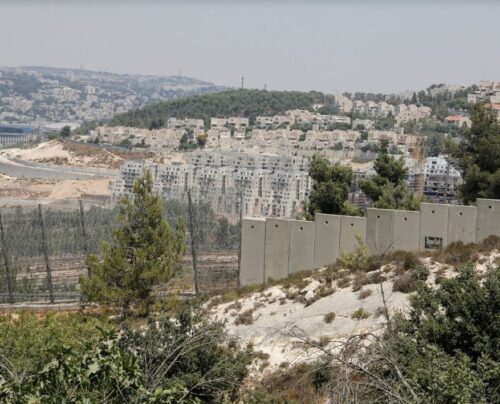
The Wall & Colonization Resistance Commission warned that Israel is advancing a sweeping plan to establish 34 new colonial sites throughout the occupied West Bank, a move the Commission described as one of the most far‑reaching expansions of the settlement enterprise in years.
Commission head Moayyad Shaaban said the decision — approved discreetly by the Israeli “cabinet” — marks “a perilous escalation in the colonial project on Palestinian land and a calculated attempt to cement irreversible realities on the ground.”
According to Shaaban, the sheer scale of the plan reflects an effort to further fracture the territorial continuity of the West Bank, tightening the isolation of Palestinian communities and deepening geographic fragmentation.
He noted that the initiative is designed to entrench creeping annexation and elevate the settlement enterprise into a de facto sovereign instrument imposed by force — in direct defiance of international law and UN resolutions that classify all Israeli colonies as illegal and void.
Shaaban said preliminary mapping tied to the decision shows extensive targeting of land in the northern West Bank, particularly around Jenin. Israel has already declared its intention to resume settlement activity in that area, this time by encircling the four evacuated colonies with additional new sites. The plan also allocates ten new colonial sites in the Hebron district, expanding Israel’s footprint in the southern West Bank.
He added that the geographic distribution of the newly approved sites reveals a deliberate push toward areas adjacent to the Green Line, signaling an effort to blur political boundaries and extinguish any remaining prospects for a two‑state outcome.
A similar pattern, he said, appears along the edges of the 1948 territories, underscoring a broader strategy to dissolve borders altogether.
Shaaban stressed that the move is not isolated but part of a cumulative policy shift. Throughout 2025, the Israeli “cabinet” reclassified 13 colonial neighborhoods as standalone colonies, approved 22 additional sites in a subsequent phase, and later authorized 19 more.
This sequence, he said, reflects a systematic transition from incremental expansion to rapid, large‑scale leaps aimed at locking in permanent control.
He warned that the latest decision comes at a moment of regional upheaval and global distraction, conditions Israel is exploiting to advance major colonial schemes with minimal scrutiny.
This, he added, highlights the Israeli government’s determination to accelerate its expansionist agenda, buoyed by international silence, inaction, or complicity.
Approving such a large number of sites in a single, secretive decision, Shaaban said, sets a dangerous precedent and underscores how central the colonial enterprise has become in reshaping the demographic and geographic landscape of the occupied West Bank.
The move, Shaaban stated, further erodes any realistic possibility of establishing a contiguous, viable Palestinian state.
Shaaban reaffirmed that these measures are legally void and cannot create rights or confer legitimacy. The Palestinian people, he said, remain rooted in their land and steadfast in their inalienable national rights.
He urged the international community to move beyond rhetorical condemnation and adopt concrete and enforceable measures aligned with its stated opposition to settlement expansion. Only decisive action, he said, can halt this dangerous escalation and hold Israel accountable for its violations.
All of Israel’s colonies in the occupied West Bank, including those in and around occupied East Jerusalem, are illegal under International Law, the Fourth Geneva Convention in addition to various United Nations and Security Council resolutions. They also constitute war crimes under International Law.
Article 33 of the Fourth Geneva Convention prohibits collective punishment and acts of terror against civilian populations.
Article 49 of the Fourth Geneva Convention states: “The Occupying Power shall not deport or transfer parts of its own civilian population into the territory it occupies.” It also prohibits the “individual or mass forcible transfers, as well as deportations of protected persons from occupied territory”.
Articles 53 and 147, prohibit the destruction of civilian property and classify pillage as a war crime.
