
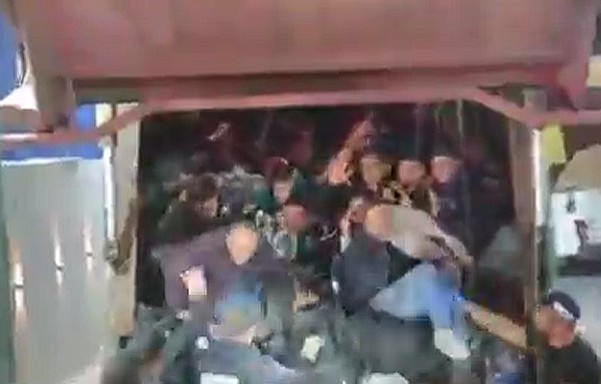
Israeli occupation forces detained dozens of Palestinian workers from the occupied West Bank after they were found hiding inside a garbage truck near an Israeli military roadblock while attempting to reach their workplaces inside Israel. The workers had resorted to this dangerous and degrading method in a desperate attempt to secure income amid the deepening economic collapse in the West Bank.
Israeli media reported that more than 60 workers were discovered inside the compactor compartment of the truck.
Several were found in a state of severe exhaustion, while others had lost consciousness due to suffocation, overcrowding, and the lack of ventilation inside the metal container. Some were transferred for medical treatment before being taken into custody.
The incident underscores the extreme risks Palestinian laborers are forced to endure as they attempt to reach jobs that have been systematically denied to them since October 2023.
Workers say they have been left with no options, as Israel has barred nearly all West Bank laborers from entering since the start of the war, cutting off the only source of income for hundreds of thousands of families.
For decades, Palestinian workers have formed a central pillar of the economy, with nearly 300,000 laborers employed inside Israel and its colonies before the shutdown. Their sudden exclusion has devastated the economic landscape, leaving families without income, savings, or social protection.
Many workers describe the situation as a slow collapse, worsened by the absence of intervention from Palestinian official institutions or labor unions to provide alternatives or emergency support.
Since October 7, 2023, Israel has revoked nearly all work permits for West Bank Palestinians, trapping hundreds of thousands of workers in their homes without income.
This abrupt cutoff plunged families into deep poverty, with many unable to afford food, rent, or basic necessities. Workers repeatedly say they feel abandoned, left to navigate a crisis with no safety net and no institutional support.
This comes in addition to dozens of workers from the Gaza Strip who were seized during Israeli military invasions across the occupied West Bank. Many were abducted, imprisoned, or forcibly transferred back to the devastated Gaza Strip, despite the collapse of all civil, economic, and humanitarian systems there.
On March 25, a Palestinian worker was killed, and eight others were injured, one seriously, after Israeli forces and illegal paramilitary Israeli colonizers pursued workers’ vehicles and opened live fire at them in Masafer Yatta, south of Hebron in the southern occupied West Bank, causing several vehicles to overturn.
A day earlier, five Palestinian workers were injured in two separate vehicular attacks by Illegal paramilitary Israeli colonizers, while Israeli forces abducted five others near Bethlehem, in the occupied West Bank, early Tuesday.
On the same day, Israeli occupation forces and illegal paramilitary Israeli colonizers chased a vehicle carrying Palestinian workers in Masafer Yatta, south of Hebron, before forcing it to stop, assaulting the workers, dragging them out, and deliberately pushing the vehicle into a nearby valley.
In recent years, and especially since the October 2023, Palestinian workers have faced escalating violence and systematic targeting.
Israeli forces have repeatedly opened fire on workers attempting to cross through gaps in the Annexation Wall or along agricultural roads. Several workers have been shot, injured, or killed while trying to reach their workplaces. Others have been beaten, stripped, or detained for hours at military roadblocks.
Economic desperation has pushed some workers to attempt dangerous crossings, including climbing the Wall, crawling through drainage tunnels, or hiding inside trucks and agricultural vehicles. These attempts often end in injury, arrest, or death. The garbage‑truck incident is the latest example of the extreme risks the workers are forced to take simply to survive.
Civil defense and human rights groups warn that the situation is worsening, with no clear plan to restore livelihoods or protect workers from violence. As one worker told reporters in a previous case, “We are either starving at home or risking death trying to reach work. There is no middle ground anymore.”
