
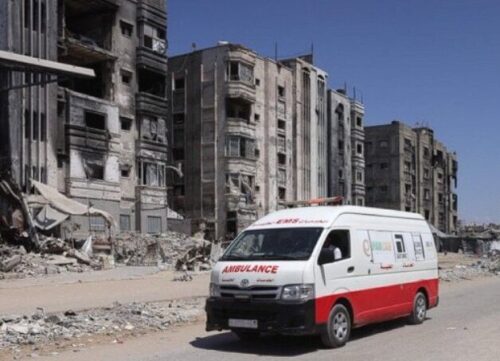
Israeli occupation forces continued violating the “ceasefire” in the Gaza Strip on Friday, launching artillery strikes, drone attacks, and demolition operations across multiple areas, particularly east of Khan Younis and north of Rafah, amid ongoing escalation in the eastern and southern parts of the city, resulting in additional deaths and injuries.
A Palestinian man was killed, and several others were injured, Friday evening when an Israeli drone fired on a group of civilians in the Zeitoun neighborhood of Gaza City.
Medical sources confirmed that the body of Louay Bassal, 27, along with multiple wounded Palestinians, arrived at al‑Ahli Hospital after a quadcopter drone targeted an area near the al‑Sham’a Mosque.
A separate drone strike near the al‑Radwan Mosque in the Asqoula area east of Gaza City wounded three more Palestinians.
In northern Gaza, a Palestinian man was injured when an Israeli missile struck a police vehicle, though the projectile did not explode.
Earlier at dawn, another Palestinian was killed northwest of Rafah, in the Gaza Strip’s southmost part, when an Israeli quadcopter drone fired a grenade at him.
Local sources identified the victim as Ra’fat Adel Ibrahim Breika, 42, a shepherd who was targeted in the al‑Shakoush area near the “yellow line.” His body was later transferred to Nasser Hospital in Khan Younis.
Israeli forces also shot and injured a woman and a child in the central Gaza Strip. Witnesses said soldiers opened fire toward civilians north of the al‑Bureij refugee camp, wounding a young girl who was taken to hospital. Another woman was shot east of Deir al‑Balah.
In a separate incident, a child was injured by fire from an Israeli quadcopter drone inside the al‑Fakhoura School in Jabalia in the northern Gaza Strip.
وہ معاہدے کہاں گئے جن سے عوام کو بیوقوف بنایا گیا تھا یہ کل کا حال ہے
غزہ سٹی کے ملبے تلے زندگی سسک رہی تھی…
ہر طرف چیخیں، دھواں اور تباہی تھی، مگر انہی کھنڈرات کے درمیان 10 سالہ معصوم بچی “مراح” کو زندہ نکال لیا گیا۔ 💔🇵🇸 pic.twitter.com/e0F6wbudMG— Sayed Ajmal khan (@Ajmal_804) May 22, 2026
Throughout the day, Israeli artillery targeted the eastern areas of Khan Younis and northern Rafah, while military vehicles fired heavily toward eastern and southern Khan Younis.
Israeli naval forces also opened machine‑gun fire toward the coast of Gaza City, and another Palestinian was reported injured by Israeli fire in Jabalia.
Overnight, Israeli forces carried out two demolition operations northeast of Khan Younis, coinciding with intense artillery bombardment on the northern and eastern parts of the city.
The Israeli army later claimed responsibility for killing three Palestinians on Thursday and Friday, alleging they posed an immediate threat to its forces near the “yellow line.”
The army said its units in northern and southern Gaza used drone strikes to “neutralize” individuals it described as threats.
As part of psychological torture, Israeli captors told Palestinian hostage from Gaza Shadi abu Seido that his family and children had been bombed and killed..
He was shocked when he was released and found them alive.. pic.twitter.com/W4bbj4Jg70
— Mahmoud Massri | مَحْمُود 🇵🇸 (@MahmoudMassri15) May 22, 2026
Meanwhile, the United Nations Relief and Works Agency (UNRWA) reported a sharp rise in skin infections across the Gaza Strip, documenting more than 125,000 cases between January and May 2026.
The agency attributed the surge to the spread of rodents and parasites amid the massive destruction, rubble, and collapse of sanitation infrastructure caused by Israel’s war on Gaza.
UNRWA said its medical teams are treating around 400 cases per day despite a severe shortage of medicine and Israel’s continued obstruction of medical supplies entering the Strip.
The “ceasefire” agreement was reached after a two‑year extermination war that began on October 8, 2023, during which Israeli forces killed more than 72,000 Palestinians and wounded over 172,000 others.
Since October 2023, Israel has imposed a near-total blockade on international journalist access to Gaza, permitting foreign journalists to enter only on brief, military-controlled tours. CPJ spoke with one of these journalists about their experience.👇 pic.twitter.com/T6vbyF8FjQ
— Committee to Protect Journalists (@pressfreedom) May 22, 2026
The genocide left catastrophic destruction across the Gaza Strip, with nearly 90 percent of the civilian infrastructure reduced to rubble, including homes, schools, hospitals, and essential public services.
A weekly crossings report also highlighted the continued Israeli restrictions on Gaza’s border points. According to the Government Media Office, only 1,287 trucks and 403 travelers were allowed through the crossings during the week, despite the urgent need for goods, fuel, and medical evacuations.
The report, covering the period between May 15 and 21, noted that just 403 Palestinians were able to travel through the Rafah Crossing — 249 departures and 154 returns — representing only 28 percent of the 1,400 individuals scheduled to cross.
The report said the restrictions on movement form part of a “systematic policy to restrict freedom of travel,” noting that Israel reopened the Palestinian side of the Rafah Crossing on February 2 in a severely limited manner after seizing control of it in May 2024.
Since then, only about 700 patients have been able to leave Gaza for medical treatment abroad, while more than 18,000 wounded and chronically ill Palestinians remain on waiting lists for evacuation. Returning travelers have also reported harsh procedures, including prolonged detention and interrogations.
Regarding goods, the report said that only 1,287 trucks entered Gaza during the week — just 30 percent of the 4,200 trucks that were supposed to be allowed in. These included 559 commercial trucks, 693 carrying humanitarian aid, and 35 fuel trucks, among them seven carrying commercial gas and 28 carrying diesel for institutions.
The Media Office warned that the reduction in the entry of goods and fuel “deepens the suffocation and blockade” imposed on the Strip, despite the ceasefire agreement of October 10, 2025, which stipulated the entry of 600 trucks of aid and goods per day, in addition to 50 fuel trucks.
