
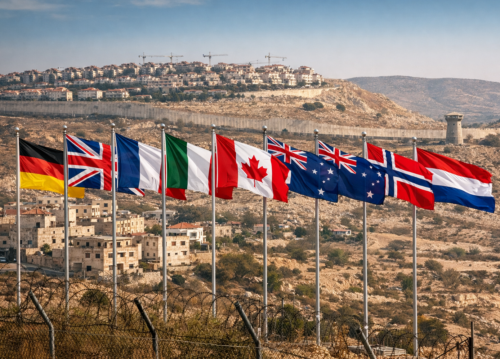
Nine Western states issued a joint statement on Friday urging the Israeli government to immediately halt its colonial expansion across the occupied West Bank, warning in particular against advancing the highly controversial “E1” project.
The statement was released by Germany, Britain, France, Italy, Canada, Australia, New Zealand, Norway, and the Netherlands.
The governments said that conditions in the occupied West Bank have “deteriorated sharply in recent months,” noting that violence by illegal paramilitary Israeli colonizers has reached “unprecedented levels.”
They cautioned that Israeli government policies—including measures aimed at entrenching Israeli control over occupied territory—are destabilizing the region and destroying any remaining prospects for a two‑state solution.
The statement reaffirmed that international law is unequivocal regarding the illegality of all Israeli colonies in the occupied West Bank, stressing that construction plans in the E1 corridor are no exception.
The nine states also urged private companies not to submit bids for construction in E1 or any other colonial projects, warning of legal exposure and reputational damage for involvement in activities that may constitute serious violations of international law.
Background on E1
The E1 plan is one of Israel’s most consequential colonial schemes. It aims to link occupied Jerusalem with the Ma’ale Adumim colonialist bloc by confiscating large areas of Palestinian land and constructing new colonies.
The project would effectively bisect the West Bank, sever Palestinian territorial continuity, and prevent the emergence of a viable Palestinian state.
Due to overwhelming international opposition, the plan has been repeatedly frozen for nearly two decades.
Additional Points in the Statement
The nine states called on Israel to:
- Halt all colonial expansion and administrative steps that advance de facto annexation.
- Ensure accountability for colonizer violence.
- Investigate allegations of abuses by Israeli forces.
- Respect the Hashemite custodianship over Jerusalem’s holy sites and maintain historical arrangements.
- Lift financial restrictions imposed on the Palestinian Authority and the Palestinian economy.
They also voiced strong opposition to calls—including from within the Israeli government—for annexing Palestinian land or forcibly displacing Palestinian communities.
Context: Escalating Annexation Measures
The statement comes amid an intensified Israeli push to expand colonies across the occupied West Bank, accompanied by a surge in colonizer attacks, home demolitions, forced displacement, and the expulsion of Palestinian communities—steps widely viewed as part of a broader annexation strategy.
On Tuesday, far‑right Israeli Finance Minister Bezalel Smotrich—who also holds a senior role in the Ministry of Defense—issued an order to forcibly evacuate the Palestinian community of Khan al‑Ahmar, east of Jerusalem.
Smotrich acted after learning that ICC Prosecutor Karim Khan had submitted a confidential request for an arrest warrant against him.
Israel’s High Court had previously authorized the demolition and evacuation of Khan al‑Ahmar, paving the way for future colonial construction in the area.
Area C and Systematic Displacement
Since the signing of the Oslo II Agreement, singed on September 24,1995, Israel has used the classification of more than 60% of the West Bank as “Area C”—under full Israeli military and administrative control—to intensify demolitions of Palestinian Bedouin communities and forcibly displace their residents.
Israel claims these communities pose a “security threat” to nearby colonies, while Palestinians and human rights organizations stress that the expulsions are part of a systematic policy to expand illegal colonies and impose irreversible facts on the ground.
All of Israel’s colonies in the occupied West Bank, including those in and around occupied East Jerusalem, are illegal under International Law, the Fourth Geneva Convention in addition to various United Nations and Security Council resolutions. They also constitute war crimes under International Law.
Article 33 of the Fourth Geneva Convention prohibits collective punishment and acts of terror against civilian populations.
Article 49 of the Fourth Geneva Convention states: “The Occupying Power shall not deport or transfer parts of its own civilian population into the territory it occupies.” It also prohibits the “individual or mass forcible transfers, as well as deportations of protected persons from occupied territory”.
Articles 53 and 147, prohibit the destruction of civilian property and classify pillage as a war crime.
