
The United Nations said Thursday that four out of five families living in shelters across the Gaza Strip face critical or catastrophic levels of hunger, while 94 percent of Palestinians in the territory require shelter assistance and basic household items amid the continuing Israeli military offensive, blockade, and restrictions on humanitarian aid.
UN Secretary-General spokesperson Stéphane Dujarric said Thursday that 94 percent of Gaza’s population is currently in need of shelter and essential household supplies as Palestinians continue to endure the effects of Israel’s military campaign and blockade on the territory.
Dujarric made the remarks during a press briefing in New York while providing an update on developments in Palestine and the wider region. The briefing came during the week of World Humanitarian Day, observed annually on Aug. 19.
Citing reports from the United Nations Office for the Coordination of Humanitarian Affairs (OCHA), Dujarric said civilians in Gaza continue to be killed, injured, or otherwise harmed as a result of Israeli airstrikes, artillery shelling, and gunfire.
He described severe conditions for displaced Palestinians, reporting that many shelters lack fuel, electricity, and essential household supplies. OCHA assessments found that four in five families in shelters face critical or catastrophic hunger.
50 bodies of Palestinians killed early in war by Israeli airstrikes buried today in Gaza
The remains could only be recovered after two years due to a lack of equipment
Many were children, some families were wiped out entirely pic.twitter.com/8MsPJOlJSJ
— RT (@RT_com) August 20, 2026
Dujarric said many shelters are already struggling with shortages of fuel, electricity, and essential household supplies, conditions that have severely affected people’s ability to sleep, prepare food, bathe, store food and water, maintain adequate lighting, and cope with extreme temperatures.
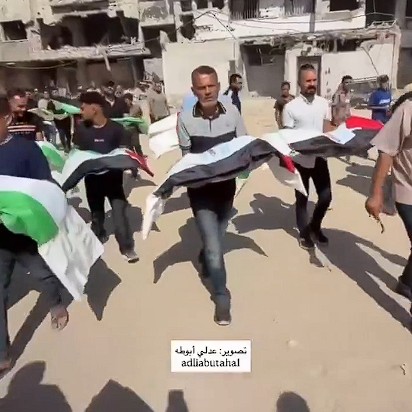
Dujarric also reported that the bodies of 50 Palestinians recovered from beneath the rubble were buried on Thursday. The victims included 19 children who had been killed more than two years ago.
“Today in Gaza, the bodies of 50 people recovered from beneath the rubble were buried, including 19 children who were killed more than two years ago,” Dujarric said.
He emphasized that efforts to remove debris and recover victims remain severely constrained by restrictions on the entry of heavy machinery, spare parts, and other critical materials, as well as limitations on access to large areas of the Gaza Strip.
According to figures released by Gaza’s Government Media Office, the Israeli military has destroyed approximately 90 percent of civilian infrastructure in the Gaza Strip during the war. The United Nations has estimated that reconstruction costs could reach roughly $70 billion.
Despite a ceasefire “agreement” that took effect on Oct. 10, 2025, Israeli military operations and other actions have continued in Gaza, including killings, detentions, bombardment, gunfire, demolitions, and further destruction of infrastructure.
TERRIFYING
Israeli occupation tanks are pushing deeper across the Yellow Line into Beit Lahia in the northern Gaza Strip, while Israeli forces intensively fire live ammunition toward Palestinians, including displaced families sheltering in the area. pic.twitter.com/etBQ6uM1cy
— Quds News Network (@QudsNen) August 20, 2026
Palestinian officials say Israel has also failed to implement provisions requiring border crossings to open and the agreed quantities of food, medicine, shelter materials, and other humanitarian assistance to enter the Gaza Strip.
Palestinian officials also accuse Israel of failing to implement provisions of the agreement related to opening border crossings and allowing the agreed quantities of humanitarian, food, medical, and shelter assistance to enter the Gaza Strip.
International officials have raised similar concerns. UN experts said humanitarian access remained critically restricted, with only two of Gaza’s six crossings reopened, while the number of aid trucks entering the territory had never reached the agreed target of 600 per day and frequently fell below half that figure.
UN humanitarian agencies have called for all crossings to open and reported that Israeli-directed rerouting and movement restrictions delayed deliveries and hindered efforts to expand relief operations.
