
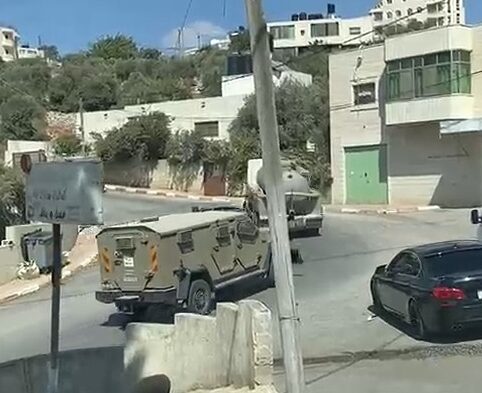
Israeli occupation forces and colonizers continued attacks across the occupied West Bank on Saturday, assaulting a Palestinian, abducting others, restricting farmers’ access to their land and forcing a Palestinian resident to demolish his own home in occupied Jerusalem.
Israeli forces abducted a young Palestinian at the Az‑Za’im military roadblock, east of occupied Jerusalem.
In the northern West Bank, the forces abducted Mohammad Nasser Al‑Saadi after invading the eastern neighborhood of Jenin.
They also abducted Adwan Al‑Karouz and his mother after invading residences near the Arab American University that were housing Palestinians displaced from the Jenin refugee camp.
The soldiers invaded several areas of Jenin governorate, intensified military restrictions, and broke into and searched several homes.
Israeli soldiers also invaded the Al‑Karaj area and advanced toward the center of Ya’bad, southwest of Jenin, where officers pursued motorcycles and established a military roadblock. Soldiers stopped residents and inspected their identification documents.
The forces also abducted Nu’man Abdullah Al‑Aseel after breaking into and searching his home in Rummana, west of Jenin.
In Tulkarem governorate in the northwestern West Bank, Israeli forces abducted Osama Zaid Awad and Sohaib Abdullah Abu Shaqra after breaking into their homes in Deir Al‑Ghusoun, north of Tulkarem.
The forces also invaded the towns of An‑Nazla Ash‑Sharqiya and Qaffin, north of Tulkarem, and searched their streets and neighborhoods. No abductions were reported during those invasions.
In Bethlehem governorate in the southern West Bank, Israeli forces abducted Karim Asakra while he was passing through the Container military roadblock, east of Bethlehem. The forces also invaded the Aida and Al‑Azza refugee camps, north of Bethlehem, and the Abu Njeim area to the east.
Israeli forces also established a military roadblock at the entrance to Marah Rabah, south of Bethlehem, where they inspected residents’ identification documents and searched vehicles. Later, the forces invaded Beit Fajjar, south of Bethlehem, deployed in several neighborhoods and patrolled the town’s streets. No abductions were reported.
In Tubas governorate in the northeastern West Bank, Israeli forces detained several farmers in the northern Yarza community, east of Tubas, and prevented them from working.
In occupied Jerusalem, Israeli forces invaded Airport Street and the Institute area in Kafr Aqab. Soldiers also fired live ammunition and concussion grenades near the entrance to the adjacent Qalandia refugee camp while passing through the area.
In Ramallah and Al‑Bireh governorate in the central West Bank, Israeli forces invaded the Al‑Am’ari refugee camp, south of Ramallah, as well as the Sateh Marhaba, Jabal At‑Tawil and Umm Ash‑Sharayet neighborhoods of Al‑Bireh. No abductions were reported.
The forces also invaded Arura, northwest of Ramallah; Abwein, Jaljulia and Ajjul, north of Ramallah; and Ein Arik, Kafr Ni’ma, Bil’in and Kharbatha Bani Harith, west of Ramallah. No abductions were reported in those areas.
Israeli forces also confiscated a wastewater suction vehicle and detained its driver in Wadi Dura Al‑Qara, east of Ramallah.
Israeli forces earlier detained two young Palestinians and forced them to reopen a blocked side road in the Shu’ab Al‑Louz area, west of Al‑Mughayyir. Soldiers also assaulted a Palestinian resident. The forces subsequently invaded Al‑Mughayyir, northeast of Ramallah, deployed throughout the village and fired tear gas canisters.
Israeli forces also repeatedly assaulted and wounded a Palestinian detainee before leaving him on a public road in Al‑Mughayyir, northeast of Ramallah.
Israeli forces also obstructed traffic at the entrance to Al‑Mughayyir, causing congestion and delaying residents on their way to work.
Later, the forces invaded Turmus Ayya, northeast of Ramallah, and deployed across the town. No abductions or home invasions were reported.
Separately, US Ambassador to Israel Mike Huckabee visited Turmus Ayya and met residents to discuss colonizer attacks and community safety. During the visit, two Israeli colonizers riding an all-terrain vehicle entered the town’s eastern area and reportedly came within approximately 100 meters of the meeting site.
Huckabee met Palestinian residents, including US citizens and relatives of US citizens killed by colonizers, and heard accounts of repeated attacks affecting families, homes and property.
After the meeting, he said Palestinian communities had a right to safety, described attacks and intimidation as criminal acts and terrorism, and called on Israeli authorities to protect residents and impose severe consequences on those responsible.
Palestinian residents said the significance of Huckabee’s remarks would ultimately depend on whether they led to concrete action. They called for stronger US pressure on Israeli authorities to protect communities and hold attackers accountable, noting that colonizers accused of violence against Palestinians are rarely arrested or prosecuted.
Huckabee acknowledged that the US Embassy had no authority to intervene directly and could only raise the cases with Israeli officials.
His remarks addressed violence against Palestinians but did not represent a change in his opposition to Palestinian statehood in the occupied West Bank.
In a June 2025 Bloomberg interview, Huckabee said he did not believe an independent Palestinian state remained a US foreign-policy objective, argued that there was no room for one in the West Bank under existing conditions, and suggested that land for such a state could instead be provided by another Muslim-majority country. The US State Department later said he was speaking for himself.
Colonizer attacks were also reported across several areas, including Al‑Mughayyir. There, colonizers accompanied by Israeli forces invaded the village’s western outskirts and grazed livestock on Palestinian-owned land near residents’ homes.
Israeli forces deployed throughout the village to protect the colonizers and fired tear gas canisters toward homes and near the mourning site for Omar Mohammad Naji Al‑Na’san and Khalil Rassem Abu Alia. No injuries were reported.
Colonizers also invaded the eastern outskirts of Burqa, east of Ramallah, and grazed livestock on Palestinian agricultural land, damaging crops and olive trees.
In Nablus governorate in the northern West Bank, colonizers destroyed electricity poles around Osarin and Beita, south of Nablus.
In Bethlehem governorate in the southern West Bank, a colonizer accompanied by livestock entered the area surrounding the Sweiss family’s home in Khalayel Al‑Louz, damaged family property and broke several trees around the house.
In Tubas governorate in the northeastern West Bank, colonizers stole several water barrels used by Palestinians in the northern Jordan Valley to store water for their livestock.
In Hebron in the southern West Bank, colonizers accompanied by dogs attacked children and women at the entrance to Shuhada Street in the city center. Israeli forces were present during the incident.
Meanwhile, in occupied Jerusalem, Israeli authorities forced Shadi Obeidat to demolish his own home in Jabal Al‑Mukabber, claiming that it had been built without a permit. His case reflected the wider practice of compelling Palestinian residents to carry out demolition orders themselves to avoid the substantial fees imposed when Israeli municipal crews undertake the demolitions.
