
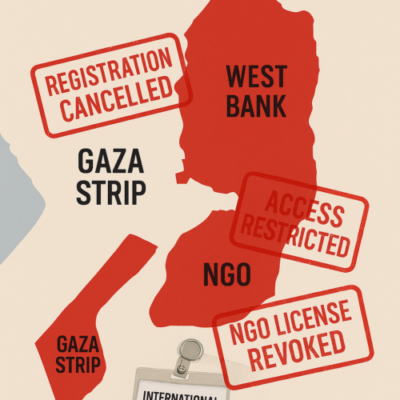
Nineteen Israeli human rights organizations have condemned the government of Benjamin Netanyahu for canceling the registration of 37 international humanitarian organizations operating in the Gaza Strip and the occupied West Bank.
In a joint statement, the organizations said: “We strongly condemn Israel’s decision to cancel the registration of international humanitarian organizations operating in the occupied Palestinian territory.”
They added: “At a time when needs in Gaza and the West Bank — including East Jerusalem — are at their most acute, these measures restrict access to life‑saving assistance.”
Among the signatories are: the Israeli Information Center for Human Rights in the Occupied Territories (B’Tselem), the Legal Center for Arab Minority Rights in Israel (Adalah), the Association for Civil Rights in Israel, Planners for Planning Rights (Bimkom(, the Center for the Defense of Freedom of Movement (Gisha), and the Israeli human‑rights and policy organization )Ir Amim(.
Additional signatories include: the Center for the Defense of the Individual (HaMoked), the Human Rights Defenders Fund, Women Against Violence and for Human Rights, Physicians for Human Rights–Israel, and the Public Committee Against Torture in Israel.
The organizations explained that, alongside Israel’s military assault on Palestinians in Gaza, humanitarian access has been severely restricted since October 2023. Despite the ceasefire, essential aid — including food, medicine, shelter, and hygiene supplies — continues to be delayed or blocked.
They stressed that canceling the registration of 37 international NGOs undermines principled humanitarian work, endangers staff and communities, and obstructs the effective delivery of aid.
The statement continued: “In the West Bank, where Israeli military, institutional, and settlement violence has reached unprecedented levels, NGOs play a critical role in supporting the most vulnerable communities, reaching those most in need, assisting local partners, and ensuring accountability and transparency. Obstructing their work puts lives at risk.”
The organizations noted that Israel, as the occupying power, is legally obligated to provide adequate supplies to Palestinian civilians — yet it not only fails to meet this obligation, but also prevents others from filling the gap.
They argued that the new Israeli measures “entrench barriers to aid and force vital organizations to suspend their operations.”
They emphasized that ensuring access to humanitarian assistance is a legal obligation, not a discretionary choice.
The joint statement called on the Israeli government to immediately halt the deregistration measures, remove obstacles to humanitarian and human rights work, and allow international organizations to operate safely and effectively.
It also urged governments and the international community to act swiftly to protect the independence of humanitarian organizations and ensure that aid reaches those in greatest need.
Last Tuesday, the Israeli government began sending formal notices to dozens of international organizations, informing them that their licenses will be revoked as of early January 2026 and requiring them to end their activities by March of the same year.
