
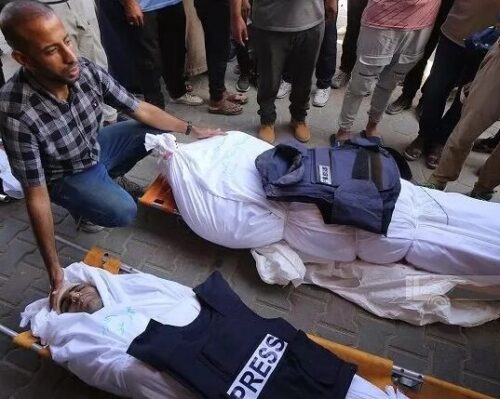
The Palestinian Journalists’ Syndicate announced on Monday its annual report on media freedoms in Palestine, confirming that 2025 was the deadliest year ever recorded for Palestinian journalists, amid systematic and deliberate genocide targeting journalists, particularly in the Gaza Strip.
The report documented the killing of 63 journalists in 2025, bringing the total number of journalists killed since the beginning of the genocide on October 7, 2023, to 256.
The Syndicate’s Freedoms Committee stated that the past year witnessed an unprecedented escalation in Israeli attacks on journalists, media workers, and press institutions.
The Committee said it conducted continuous field monitoring, documentation, and verification of violations throughout 2025, relying on sworn testimonies and internationally recognized professional standards.
The report aims to provide a comprehensive analytical record of the year’s violations and to demonstrate the systematic nature of Israel’s targeting of Palestinian journalists, forming a rights‑based document for international accountability.
During a press conference at the Syndicate’s headquarters in Ramallah, Syndicate President Nasser Abu Bakr said the 2025 report coincides with ongoing Arab and international efforts to pursue accountability for the killing of Palestinian journalists.
He noted that since the beginning of the genocide, the Syndicate has been working on multiple fronts, including global advocacy campaigns with unions, civil society organizations, and media outlets.
Abu Bakr confirmed that the Syndicate, in partnership with the International Federation of Journalists (IFJ), has submitted complaints to the International Criminal Court, and that the IFJ is preparing a comprehensive complaint covering all crimes committed against journalists in Gaza, Jerusalem, and the West Bank.
He added that another complaint has been submitted to the UN Human Rights Council, stressing that efforts to hold those responsible for the killing of 256 Palestinian journalists will continue, and described the ongoing campaign as the first genocide in modern history specifically targeting journalists.
Abu Bakr also warned of the deteriorating health of journalist Ali al‑Samoudi, who is held under Administrative Detention, without charges or trial.
He said al‑Samoudi has lost nearly 40 kilograms and suffers from chronic illnesses, placing his life at serious risk inside Israeli prisons.
Speaking at the conference, Mohammad al‑Lahham, head of the Freedoms Committee, said that numbers alone cannot capture the scale of the catastrophe.
He emphasized that the pattern of killings in Gaza reflects a deliberate, centrally directed policy aimed at eliminating the journalistic presence in the Strip.
Al-Lahham said most journalists were killed by direct bombardment, gunfire, or targeted attacks while performing their professional duties, in clear violation of International Humanitarian Law, which guarantees the protection of media workers.
Al‑Lahham added that dozens of journalists’ family members were also killed when their homes or displacement shelters were bombed, describing this as a form of collective punishment intended to break journalists’ morale and prevent them from continuing their work.
He noted that the Freedoms Committee documented dozens of serious injuries caused by shrapnel, bullets, and airstrikes, in addition to cases of administrative and field detention, interrogations, and summonses—amounting, he said, to the criminalization of journalism and an attempt to impose coercive control over Palestinian media.
The report also documented the destruction of media offices, broadcast equipment, and production facilities, which has devastated the media infrastructure and obstructed field coverage. Hundreds of cases of detention, obstruction of coverage, intimidation, live fire, verbal assaults, and incitement were also recorded.
Al‑Lahham highlighted the ongoing enforced disappearance of several journalists whose whereabouts have been unknown since the beginning of the assault on Gaza, holding Israeli authorities fully responsible for their fate and demanding immediate disclosure of their locations.
He added that most journalists in Gaza have been forcibly displaced, lost their homes and equipment, and now live in harsh humanitarian conditions in shelters and camps, severely affecting their ability to continue reporting.
The Syndicate concluded its report by stating that the violations documented throughout 2025 constitute grave breaches of International Humanitarian Law, and called on international and UN bodies to take urgent action to protect Palestinian journalists, hold perpetrators accountable, and prevent impunity.
