
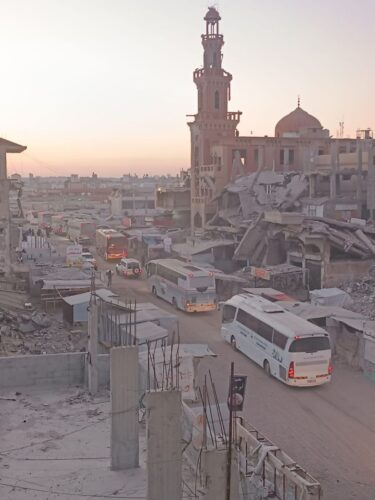
The Al-Qassam Brigades, the military wing of Hamas, publicly reaffirmed their commitment to the prisoner exchange agreement with Israel, stating that their adherence remains conditional on Israel fulfilling its obligations.
The announcement coincided with the launch of the first phase of the exchange, conducted under a ceasefire framework mediated by Egypt, Qatar, Turkey, and the United States. Negotiations were held in Sharm el-Sheikh.
As part of the deal, Al-Qassam released 20 Israeli hostages alive. The first seven were handed over to the International Committee of the Red Cross (ICRC), followed by thirteen more in the second round.
According to Israel’s Channel 12, the ICRC confirmed receipt of all 20 captives, completing the transfer of all living Israeli hostages held in Gaza.
|Prisoner Exchange Begins Under Fragile Truce|
The only remaining Israeli captives are 28 individuals confirmed dead. Their bodies are expected to be handed over later today, pending forensic procedures and coordination with international teams.
However, logistical constraints—including Israeli military presence across Gaza and widespread destruction—have raised uncertainty about the exact timing of the handover.
Palestinians in Gaza are celebrating a ceasefire announcement after two years of genocide, mass killing, displacement, destruction and starvation. pic.twitter.com/SKH0PjE9AN
— AJ+ (@ajplus) October 13, 2025
Hamas has accused Israel of obstructing mediation efforts and failing to recover its captives through military operations.
Hamas also claimed that Israel could have secured the captives months earlier but delayed negotiations.
Under the terms of the agreement, Israel will release 250 Palestinian prisoners serving long sentences, including dozens with life terms. Of these, 135 will be sent to Gaza or third countries, 100 will return to the occupied West Bank, and 15 to East Jerusalem.
 Additionally, approximately 1,700 Gazans detained since October 2023 are slated for release, including 22 minors and hundreds held in military custody.
The deal was officially announced by U.S. President Donald Trump, who described it as a “historic breakthrough.” His visit to Israel and Egypt coincides with the implementation of the agreement and a regional summit focused on post-war arrangements.
Human rights organizations confirm that the Palestinian detainee population includes journalists, elderly individuals, and people with serious medical conditions.
Israel unilaterally broke the last ceasefire in Gaza.
AJ+ spoke to journalist and analyst @omarrahman about what might make this deal different. pic.twitter.com/T7usnqwOTK
— AJ+ (@ajplus) October 12, 2025
Legal advocates continue to call for international oversight, citing violations of international law and the Geneva Conventions.
As of October 2025, over 11,000 Palestinians remain in Israeli detention. Many are held under harsh conditions, including documented cases of torture, starvation, and medical neglect, which have led to multiple deaths in custody.
Among the detainees are 53 women, including three from Gaza and two minors, and approximately 400 children, most held in Ofer and Megiddo prisons. Between 3,300 and 3,600 Palestinians are held under administrative detention, a policy that allows imprisonment without charge or trial.
