

Israeli occupation forces carried out widespread invasions across multiple areas of the occupied West Bank on Monday, storming towns and villages, abducting residents, firing live rounds at civilians, and imposing movement restrictions while escorting illegal paramilitary colonizers.
The coordinated assaults targeted communities in Ramallah, Jerusalem, Hebron, Nablus, Jenin, Qalqilia, Bethlehem, and Tulkarem, leaving behind damaged homes, injured civilians, seized properties, and heightened fears of further land confiscation.
In the Ramallah governorate in the central West Bank, Israeli soldiers abducted Munther Tawafsha and Izz Khalil after invading and ransacking their homes in Sinjil, northeast of Ramallah.
The army also abducted Alaa Abu Alia and Hani Abu Alia during its invasion of al‑Mughayyer village, northeast of Ramallah, where troops provided armed protection for colonizers and fired toxic gas at homes.
Israeli forces later moved toward Sahel Marj Si‘a, and then into the Shu‘ab al‑Louz area west of al‑Mughayyer, where they abducted Mohammad Khairallah Na’san, detained several young men, and deployed additional reinforcements amid repeated attacks by soldiers and colonizers on residents and agricultural lands.
Soldiers further invaded Turmus Ayya, Birzeit, Burham, and al‑Mazra’a al‑Gharbiyya, deploying military vehicles through residential streets without reporting abductions.
In occupied Jerusalem, Israeli forces invaded al‑‘Isawiya, stormed the home of Ahmad Sha’ban Ubeid, searched it, and abducted him.
Later in the day, soldiers opened live fire at Palestinians near the Ottoman Palace roundabout close to ar‑Ram town, northeast of Jerusalem, and spread throughout the Abu al‑Shaheed roundabout and the northern entrance of the town.
In the Hebron governorate in the southern West Bank, Israeli soldiers opened live fire at a Palestinian shepherd in Wadi al‑Bayda west of Ethna, killing three of his sheep and injuring several others while he was grazing his flock.
In the Nablus governorate in the northern West Bank, Israeli forces invaded ‘Awrata, Beita, and ‘Einabus south of the city, and Beit Furik and Salem to the east. Troops stormed numerous homes, ransacked them, and interrogated residents in the streets.
Soldiers also invaded al‑Lubban al‑Sharqiya village, south of Nablus, firing toxic gas toward homes, and later invaded Nablus City from the Deir Sharaf military roadblock, roaming several streets and reaching the vicinity of the Old City.
At dawn, troops invaded Balata refugee camp, east of Nablus, stormed homes, and opened heavy fire, injuring a young man with shrapnel in the foot before abducting Raed Da’ous, Taha al‑Saqa, Mohammad Jihad Mashah, Raed Yahya Faraj, and Nasser Abu Thabet.
Later in the evening, Israeli forces invaded the village of Tell, southwest of Nablus, forced residents of several homes to evacuate, and prepared to demolish the home of Farouq Ramadan, whose family lost four members in a colonizer attack on July 24.
Furthermore, the soldiers invaded the village of Jalud, southeast of Nablus, occupied a Palestinian home, and raised the Israeli flag on its rooftop.
In the Jenin governorate in the northern West Bank, Israeli occupation forces seized the home of Hazem Shafi’i Hamad in the al‑Ras ash‑Shamali area north of Arraba, expelled his family, and converted the property into a military post.
Soldiers also closed the Arraba station area and the Ya’bad road, disrupting movement on one of the main routes linking Arraba with surrounding communities.
In addition, the soldiers invaded the eastern neighborhood of Jenin City, stormed homes, interrogated residents, and abducted Ahmad Jalamna and Ashraf Hantouli.
In Jalbun, east of Jenin, soldiers invaded several homes and abducted Abdullah Essam Abu ar‑Rob, while additional forces invaded al‑Silah al‑Harithiya, al‑Yamun, and Ya’bad, searching homes without reporting abductions.
In the northern Jordan Valley, Israeli occupation forces abducted two brothers, Luay and Ehab Qadri Daraghma, from the Ein al‑Hilwa area.
The closure of roads and military activity coincided with Israeli actions targeting lands along the road, raising fears of bulldozing, uprooting olive trees, and seizing large areas of agricultural land.
In the Qalqilia governorate in the northwestern West Bank, Israeli forces invaded the city from its main eastern entrance with several military vehicles and deployed in the Naqqar neighborhood.
In the Bethlehem governorate, Israeli soldiers invaded the Solomon’s Pools area between al‑Khader and Artas, south of Bethlehem, and later set up a military roadblock at the entrance of Battir, stopping vehicles and inspecting the IDs of residents.
Troops also invaded al‑‘Ubeidiya, Dar Salah, al‑Shawawra, and Za’tara without reporting abductions.
In Marah Rabah, south of Bethlehem, Israeli forces abducted Yousef Ahmad Mohammad Sheikh, Yousef Ja’far Ahmad Sheikh, Omar Hussein Mohammad Sheikh, Wisam Walid Mousa Sheikh, Taha Mousa Mohammad Sheikh, Alaa Ahmad Mohammad Sheikh, Yousef Taha Qassem Sheikh, Ward Mohammad Mustafa al‑Sheikh, Khalil Qassem Mohammad Sheikh, and Khalil Nazeer Khalil Sheikh after storming and searching their homes.
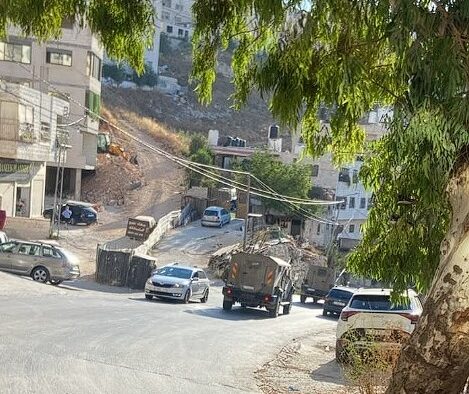 In Wadi Fukin, southwest of Bethlehem, soldiers stormed the home of Adel Mohammad Yousef al‑Hroub and forced his family outside throughout the invasion.
In the Tulkarem governorate in the northwestern West Bank, Israeli forces invaded ‘Attil, Zeita, and Baqa ash‑Sharqiyya, obstructing movement and conducting extensive searches.
Later in the evening, troops invaded Bal’a, ‘Illar, and Seida, stormed the home of Mohammad Amin Hamdan in Bal’a and searched it, while military vehicles roamed the main streets of ‘Illar and Seida, blocking traffic.
In the village of Jarushiya, north of Tulkarem, Israeli forces stormed the home of Walid al‑Zaghoul, expelled his family, and converted the property into a military post for 24 hours while deploying troops throughout the area.
These are some of the documented and verified Israeli military invasions and violations reported today.
Due to the intensity and ongoing nature of these attacks, additional incidents may go underreported or unreported, especially in areas where journalists and field teams are unable to safely reach affected communities.
