
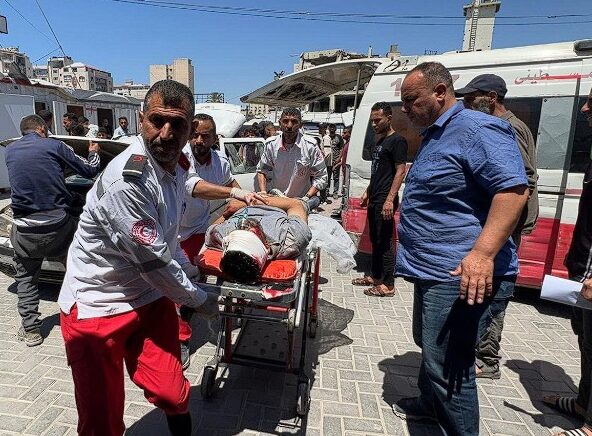
Israeli occupation forces continued violating the “ceasefire” agreement in the Gaza Strip for the 305th consecutive day, carrying out coordinated attacks across southern, central, and northern Gaza while maintaining the blockade and tightening restrictions on aid entry and civilian movement.
In southern Gaza, medical sources confirmed the death of 13-year-old Saba Na’im Abdullah al-Hashash from critical head wounds sustained on Saturday, when Israeli soldiers shot her in the al-Iqlimi area of al-Mawasi, south of Khan Younis.
Relatives told Drop Site News that Saba Na’im Abdullah was sitting in a makeshift prayer space inside a tent, memorizing the Quran, when an Israeli bullet struck her.
Muhammad al‑Rabai’a described relentless Israeli tank and quadcopter fire targeting displaced families sheltering in tents, saying, “A child goes to memorize the Quran and is directly targeted.”
Another relative, Salem al‑Rabai’a, told Drop Site News that Saba’s sister had been killed in the same area the previous year. “Last Thursday marked the anniversary of her sister’s death, and today the second sister was killed,” he said, adding, “They talk about a ceasefire, but we don’t see it. All we see is gunfire pouring down on the tents.”
🇵🇸 “Last Thursday was the anniversary of her sister’s death, and today the second sister was martyred.”
Israeli forces shot 13-year-old Saba al-Hashash in the Al-Iqlimi area of al-Mawasi, Khan Younis, in Gaza, on Saturday, August 8. She died of her wounds today, becoming the… pic.twitter.com/p92KIDuov7
— Drop Site (@DropSiteNews) August 10, 2026
Israeli tanks opened intense fire toward Qizan Rashwan, north‑east of Khan Younis, while artillery shelled al‑Tina Street in the southern part of the city.
Additional tank fire targeted homes near al‑Mahatta Mosque on Yaffa Street in the Tuffah neighborhood of Gaza City.
Also in Gaza City, Israeli naval vessels fired toward the coastline, while artillery struck al‑Sikka Street in the Shuja’iyya neighborhood, causing further damage to civilian homes and infrastructure.
In northern Gaza, several Palestinians were injured by Israeli gunfire outside areas under Israeli control in Jabalia, while armored vehicles advanced into Beit Lahia, firing heavily toward residential homes.
In central Gaza, Israeli artillery targeted northeastern al-Bureij refugee camp and nearby areas.
Separately, the Palestinian Water Authority said the destruction of Gaza’s wastewater treatment systems and related infrastructure has severely worsened environmental and public-health conditions, with large quantities of untreated sewage flowing directly into the sea.
Spokesperson Adel Yassin said the shutdown of treatment plants has turned Gaza’s beaches into polluted areas that threaten public health, after they once served as the only outlet for residents and displaced families amid overcrowded shelters.
I will never forget this bombardment for as long as I live
The Israeli bombardment was so intense that it felt as though an earthquake that would not stop was shaking everything around us. Communications were completely cut off, and we did not know where to go or where we could… pic.twitter.com/6Yd1p3RBL3— Ahmed Ashour 𓂆🇵🇸 (@AhmedAAshour8) August 10, 2026
He warned that the continued discharge of sewage into the sea has created conditions conducive to the spread of diseases, particularly skin and intestinal illnesses, posing serious risks to all age groups.
Against this backdrop, only 133 Palestinians were permitted to leave Gaza on Monday through the Karem Abu Salem (Kerem Shalom) crossing, including 52 patients and 81 companions traveling for medical treatment outside the Strip.
The departure took place despite the continued closure of most crossings and severe restrictions on travel, in contradiction to provisions in the ceasefire agreement requiring facilitation of humanitarian movement.
Human rights organizations continue to call for opening the crossings and enabling the travel of patients, wounded individuals, and urgent humanitarian cases trapped inside the besieged enclave.
These attacks came despite U.S. President Donald Trump’s July 31 announcement of a new agreement intended to advance the ceasefire roadmap into its second phase.
Mourners bid farewell to 13-year-old Saba Al-Hashash after she was killed by Israeli fire in Al-Mawasi, Khan Younis, just days after the anniversary of her sister’s killing by Israeli forces in 2025. pic.twitter.com/6bpsxVE0Im
— PALESTINE ONLINE 🇵🇸 (@OnlinePalEng) August 10, 2026
Israeli Prime Minister Benjamin Netanyahu formally rejected the 15-point document proposed by the Peace Council, saying Israeli forces would not withdraw until Hamas was fully disarmed.
Hamas, meanwhile, reaffirmed its commitment to what was agreed with mediators, calling for a clear timetable to complete the second phase of the ceasefire agreement.
The attacks unfolded amid worsening humanitarian conditions and escalating risks to civilians and displaced families, as the effects of what Palestinian officials and human rights organizations describe as genocide, together with the blockade, continued across the Strip.
The mediated “ceasefire” agreement was signed on October 10, 2025, in Sharm el-Sheikh under Arab and U.S. mediation and took effect on October 11, yet Israeli forces have continued military operations and field violations since then.
During the previous 24 hours, the Palestinian Health Ministry in Gaza said hospitals received six injured Palestinians.
Since the “ceasefire” took effect on October 11, 2025, the Ministry said 1,258 Palestinians have been killed, 4,145 injured, and 807 bodies recovered.
The cumulative toll of Israel’s genocide in the Gaza Strip since October 7, 2023, has reached 73,386 killed and 174,256 injured, according to the Palestinian Health Ministry in Gaza, which published its latest figures on August 10, 2026.
The Ministry added that a number of victims remain under the rubble and in the streets, as ambulance and civil defense crews are still unable to reach them.
