
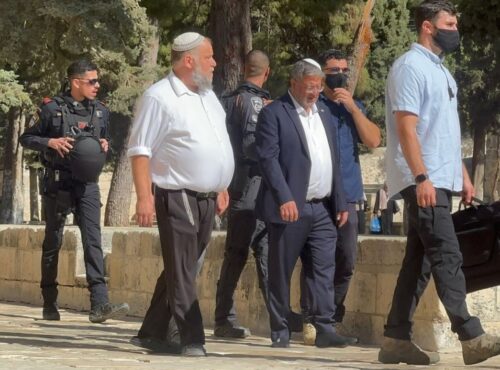
On Tuesday, Israeli far-right, National Security Minister Itamar Ben-Gvir led dozens of colonizers in a heavily guarded incursion into Al-Aqsa Mosque in occupied East Jerusalem. The visit coincided with the final day of the Jewish holiday of Sukkot and marked his second such appearance at the site within a week.
According to the Islamic Waqf Department, the colonizers toured the mosque compound under the protection of Israeli police, who simultaneously imposed sweeping restrictions on Palestinian worshippers. Access to the mosque was severely curtailed, with roadblocks and checkpoints erected at its gates and throughout the Old City.
Ben-Gvir’s repeated presence at Al-Aqsa has drawn sharp criticism from Palestinian officials and rights advocates, who view these incursions as part of a broader campaign to alter the status quo at the holy site and assert Israeli sovereignty.
Video By Silwanic
Al-Aqsa Mosque remains a flashpoint in the Israeli-Palestinian conflict, and such actions are widely interpreted as deliberate provocations that risk igniting further unrest.
The timing of the incursion reflects a broader escalation across the occupied Palestinian territories.
Since October 2023, Israeli colonizer violence has surged dramatically, with over 7,000 documented attacks. These include assaults on Palestinian farmers during the olive harvest, arson targeting vehicles and homes, and widespread destruction of agricultural lands.
Human rights organizations have repeatedly warned that many of these attacks occur under the protection—or in the presence—of Israeli soldiers, reinforcing a climate of impunity.
In the northern West Bank, Israeli military bulldozers recently sealed off key access roads to the village of Al-Lubban ash-Sharqiya near Nablus, compounding the isolation of Palestinian communities.
The main entrance to the village has remained blocked since October 7, forcing residents to rely on rugged, unpaved detours.
These developments are not isolated. They form part of a systematic pattern of territorial entrenchment and demographic pressure that is reshaping daily life across the West Bank. Coupled with the humanitarian catastrophe unfolding in Gaza—where over 67,000 Palestinians have been killed and 90% of the population displaced.
