
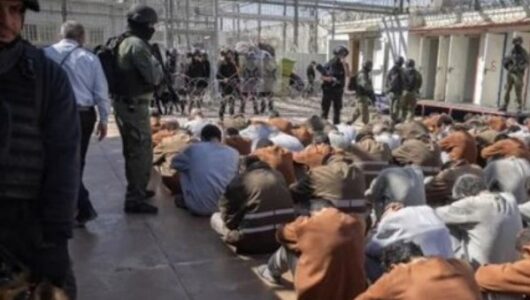
The Palestinian Commission for Detainees and Ex‑Detainees Affairs reported that Palestinians held in Ofer Prison and the Negev (Naqab) Prison are enduring extremely harsh humanitarian conditions, following a recent visit by the Commission’s legal team.
According to the Commission, the visit revealed a deeply deteriorating environment inside both facilities, where detainees face severe physical and psychological strain due to prolonged neglect and punitive measures imposed by Israeli authorities.
The legal team documented a clear accumulation of untreated medical conditions, including chronic illnesses that have worsened due to the systematic denial of medical care, the acute shortage of essential medications, and the absence of regular health monitoring.
Lawyers noted that several detainees are suffering complications that could have been prevented with timely treatment.
The Commission added that detainees are experiencing a severe shortage of clothing and blankets, forcing them to rely on worn‑out, inadequate items that fail to protect them from cold weather—conditions that violate basic humanitarian and international standards.
Detainees also reported ongoing deprivation of family visits, which has caused significant psychological distress.
In addition, they described frequent and sudden transfers between prison sections or between different prisons, a practice widely viewed by rights groups as a deliberate method of psychological pressure and disorientation.
The legal team further documented complaints of continuous abuse, including humiliating strip searches, collective punishments, and daily restrictions that undermine detainees’ dignity and fundamental rights.
These practices, the Commission said, reflect a broader pattern of punitive policies that have intensified since late 2023.
Human rights organizations—including Ad-Dameer Prisoner Support and Human Rights Association, Human Rights Watch, and Amnesty International—have previously warned that conditions in Israeli prisons have sharply deteriorated, particularly after the imposition of emergency regulations that expanded the use of solitary confinement, reduced food portions, and restricted access to basic necessities.
Since late 2023, Israeli prison conditions have sharply deteriorated following emergency directives issued by the Israeli government and prison authorities. Human rights organizations—including Ad-Dameer, Human Rights Watch, Amnesty International, and the UN Working Group on Arbitrary Detention—have documented a series of escalating violations affecting Palestinian detainees across all major facilities.
Key developments since 2023 include:
- Severe reduction in food portions, with detainees reporting hunger and malnutrition‑level shortages.
- Systematic denial of medical care, including cancellation of specialist appointments and withholding of chronic‑illness medications.
- Expansion of solitary confinement, often for extended periods and without judicial oversight.
- Confiscation of clothing, blankets, and personal items, leaving detainees exposed to extreme temperatures.
- Restrictions on family visits, in some cases amounting to total suspension for months.
- Increased use of collective punishment, including mass cell searches, beatings, and punitive transfers.
- Overcrowding, with detainees held in cells far exceeding capacity.
- Escalation of psychological pressure, including sudden nighttime transfers and prolonged shackling during movement.
Rights groups describe these measures as part of a broader punitive regime that intensified after October 2023, disproportionately affecting detainees from the occupied West Bank and Gaza.
These practices constitute grave violations of international law, including the Geneva Conventions, and held Israeli authorities fully responsible for the safety and well‑being of detainees.
