
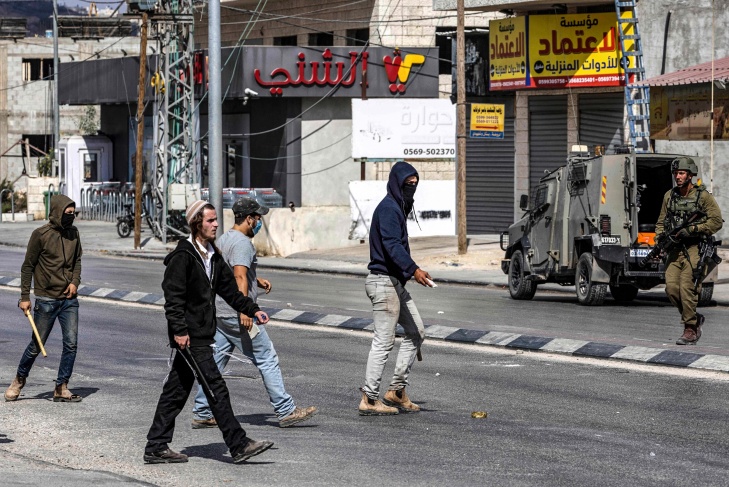
Report: The National Bureau for Land Defense and Resistance to Colonization reported Saturday a record surge in violence perpetrated occupation forces, and by illegal Israeli paramilitary colonizers, affiliated with extremist figures such as Itamar Ben-Gvir.
The report documents a deliberate expansion of destruction across Palestinian towns and villages in the occupied West Bank, with the village of Al-Mughayyir emerging as a stark example of collective punishment and military aggression.
Al-Mughayyir Under Siege
Located northeast of Ramallah, in the central West Bank, al-Mughayyir has endured a sustained military campaign involving curfews, land seizures, and widespread destruction.
Israeli forces imposed a blockade, uprooted hundreds of olive trees, razed agricultural lands, and inflicted severe damage on infrastructure.
These actions mirror similar punitive operations in Bruqin, Deir Ballout, Kafr Malik, Burqa, Umm al-Kheir, Duma, Qusra, and other rural communities across the West Bank.
Since October 7, 2023, attacks on Al-Mughayyir have intensified, with Israeli troops and armed colonizers alternating assaults on residents. Homes were ransacked, movement restricted, and essential services, including medical facilities, shut down.
The Israeli military seized 267 dunams of village land for “military purposes,” affecting over 4,000 residents.
Of the village’s original 43,000 dunams, less than 1,000 remain accessible to Palestinians. Surrounded by nine colonial outposts, Al-Mughayyir has become a flashpoint of resistance and repression.
One of the most violent incidents involved 1,600 armed colonizers storming the village, torching over 40 homes and vehicles.
Military–Militia Nexus and Reports of War Crimes
The Israeli military operating in the West Bank, composed largely of colonizer recruits, is directly complicit with settler militias and extremist groups based in outposts and settler-run ranches.
On July 25, the Association for Civil Rights in Israel filed a formal complaint to the Military Advocate General, demanding a criminal investigation into Central Command Chief Avi Blot for suspected war crimes in the West Bank.
This marks the first legal challenge against a senior Israeli officer for crimes committed in the West Bank since the onset of the war on Gaza.
The complaint highlights the normalization of war crimes and crimes against humanity, noting that the military has not only acknowledged these acts but embraced them.
The same “no innocents” doctrine deployed in Gaza has now been rebranded as “shaping operations” in the West Bank.
The Al-Mughayyir campaign alone involved the uprooting of 3,100 trees, extensive property damage, and collective punishment of the civilian population.
UN Documentation of Colonizer Violence
According to the UN Office for the Coordination of Humanitarian Affairs (OCHA), over 1,000 attacks by Israeli colonizers have been recorded in 230 Palestinian communities since the start of 2025.
These assaults resulted in casualties and property damage, with 60% concentrated in Ramallah, Nablus, and Hebron governorates.
Eleven Palestinians were killed—five by colonizers, five by Israeli forces, and one by unknown assailants. Another 696 were injured, including 473 by colonizers and 217 by Israeli forces.
In comparison, 2024 saw 11 Palestinian fatalities and 486 injuries from colonizer-led attacks. The data underscores a sharp escalation in settler violence and military complicity.
Duma: A Village Haunted by Past and Present Crimes
Nearby, the village of Duma remains under siege by colonizers and occupation forces. Both Duma and Al-Mughayyir overlook the central Jordan Valley, making them strategic targets for Israeli expansion.
In a chilling echo of past atrocities, Palestinian youth Thamin Dawabsha was fatally shot by Israeli colonizers days after the tenth anniversary of the Dawabsha family massacre, which claimed the lives of infant Ali Dawabsheh and his parents.
Following Thamin’s funeral, a colonizer from a nearby outpost published a Telegram post inciting arrests, featuring photos of mourners with their faces circled. That night, Israeli forces raided the village and detained five individuals identified in the post—an act emblematic of the collusion between settler incitement and military enforcement.
Khirbet Umm al-Kheir: A Village Under Siege and Systematic Erasure
In the South Hebron Hills, the village of Khirbet Umm al-Kheir remains gripped by collective punishment and settler violence. Following the killing of Palestinian activist Odah al-Hathaleen by an Israeli colonizer in July, shot while peacefully resisting land bulldozing, Israeli forces imposed a lockdown on the village.
Despite the gravity of the crime, the Jerusalem Magistrate’s Court released the perpetrator, colonizer Yinon Levi, and allowed continued land clearing operations on Palestinian-owned property.
Just one day after the funeral tent was erected, Israeli forces expelled journalists, activists, and visitors from outside the village, shut down the mourning site, and threatened residents with mass expulsion.
According to Sheikh Ibrahim al-Hathaleen, head of the Khirbet Umm al-Kheir council, an Israeli officer declared that the entire village could be forcibly displaced “with ease.”
Khirbet Umm al-Kheir, one of the oldest villages in southern Hebron, is home to 32 families—around 210 people. Every home is under threat of demolition, with official notices already issued.
Over the past two decades, the village has endured 18 demolition campaigns targeting homes, livestock shelters, and private property. Adjacent to the Carmel settlement, established in 1980 on confiscated village land, Umm al-Kheir faces relentless pressure.
Yinon Levi, the colonizer responsible for Odeh’s killing, resides in the illegal outpost “Metarim,” which he founded in 2021. He lives with his family and livestock, protected by surveillance systems and private security.
Levi owns a demolition and construction company and was sanctioned in 2024 by the United States, European Union, and United Kingdom for leading violent campaigns against Palestinians in southern Hebron, including physical assaults, destruction of farmland, and death threats.
Institutionalizing Colonizer Militias: Ben-Gvir’s Armed Expansion
This case exemplifies the deep entanglement between Israeli colonizers and occupation forces in the West Bank. As Israeli troops were redeployed to Gaza, the government filled the vacuum with settler recruits, many operating as armed militias under the direction of National Security Minister Itamar Ben-Gvir.
On July 10, Ben-Gvir announced the formation of a settler-based police unit tasked with enforcing Israeli “sovereignty” over the occupied West Bank. He armed these units with military-grade weapons and instructed police forces not to cooperate with internal oversight bodies such as Shin Bet in curbing settler violence.
Later that month, Ben-Gvir launched a “Rapid Response Unit” during a ceremony at the Ibrahimi Mosque in Hebron. According to Israeli police statements, the unit includes over 100 colonizer volunteers trained in combat and granted special policing powers.
The initiative, framed as “a strategic lesson from October 7”, signals a formal escalation in settler militarization and state-backed aggression.
Deputy Police Commissioner Avshalom Peled described the unit as a “voluntary force” supporting Israeli police in “enhancing personal security” for settlers in “Judea and Samaria”—a term used by Israeli authorities to refer to the occupied West Bank.
Ben-Gvir praised the volunteers as “an inseparable part of society,” calling their deployment a “real sovereignty and practical Zionism.”
This militarized expansion aligns with a letter signed by 14 Israeli ministers and Knesset Speaker Amir Ohana, urging Prime Minister Netanyahu to immediately apply Israeli sovereignty over the West Bank.
Formalizing Land Theft: Plans to Legalize 17 Illegal Outposts
In a separate development, Israeli media revealed that Prime Minister Netanyahu, Finance Minister Bezalel Smotrich, and other officials attended a settler council dinner near Ramallah celebrating plans to “legalize” 17 illegal outposts.
Yisrael Gantz, head of the Mateh Binyamin settler council, announced that most of these outposts, primarily agricultural, would be converted into officially recognized settlements.
These outposts, built on stolen, privately owned Palestinian land, are slated for full infrastructure development, including schools, clinics, and parks. The move would permanently entrench these colonies and justify further land confiscation under the guise of “public benefit.”
Observers warn that this step directly advances the Israeli settlement enterprise and undermines any prospect of a sovereign Palestinian state.
Looming Annexation: Cabinet to Discuss Sovereignty Declaration
In response to growing international recognition of Palestinian statehood, expected at the UN General Assembly in September, the Israeli security cabinet is reportedly preparing to declare sovereignty over parts of the occupied West Bank.
According to “Kan 11” Israeli news agency, one proposal involves formal annexation of select areas.
Finance Minister Smotrich has called for full annexation and the dismantling of the Palestinian Authority—an extreme position opposed by Israeli security officials.
Countries expected to recognize Palestine next month include France, Spain, Ireland, Malta, Norway, Australia, Canada, New Zealand, Finland, Luxembourg, Portugal, and San Marino.
Weekly Documentation of Israeli Colonial Violations in the Occupied West Bank, compiled by the National Bureau for Land Defense and Resistance to Colonization
Jerusalem Governorate
- Forced Displacement in Umm Tuba: 17 Palestinian families received eviction orders in the al-Mashahid neighborhood. The Israeli authorities claim the land belongs to the so-called “Jewish National Fund.”
- Demolitions in Sur Baher: Livestock shelters and agricultural structures, established over 16 years ago, were destroyed in Wadi Sabiha, affecting families from Sur Baher, as-Sawahra, and al-Obeidiyya.
- Demolition Orders in Arab al-Ka’abna: Three homes belonging to brothers who have lived in the area for over 40 years were targeted for demolition.
- Land Destruction in al-‘Isawiya: Israeli bulldozers razed farmland, destroyed a farming room, water tanks, and fencing.
- Colonizer Assault in Jaba’: A 50-year-old Palestinian was hospitalized after being attacked by Israeli colonizers near Jerusalem.
Hebron Governorate
- New Colonial Outposts in Masafer Yatta: Three new outposts were erected, including mobile homes and a large menorah, consuming approximately 6,400 dunams of land in Birin.
- Land Clearing near Havat Maon: Israeli colonizers bulldozed large swaths of farmland in al-Hamra.
- Assaults on Shepherds in al-Mufaqarah: Colonizers attempted to steal livestock; residents and international activists intervened.
- Excavation in ar-Rihiya: Israeli bulldozers began road construction and land leveling on privately owned farmland—likely a prelude to settlement expansion.
- Violent Assault in Khirbet al-Qat: Elderly man Mustafa Abdul Qader Milhem (60) and youth Ayed Yousef Milhem were severely beaten with stones and batons while harvesting grapes.
Bethlehem Governorate
- Demolition Notices in Husan: Multiple commercial establishments, including grocery stalls, car washes, and hardware shops, were served demolition orders.
- Demolition in al-Jab’a: A farming room was destroyed under the pretext of lacking permits.
- Olive Tree Vandalism in al-Minya: Dozens of olive trees belonging to the heirs of Abdul Hadi Muhammad al-Mutawer were cut down. A colonial outpost established on July 13 in Jabal al-Qarn has become a launchpad for intensified settler attacks.
Ramallah Governorate
- Expansion of Outpost in ‘Atara: Colonizers installed a ninth tent, water tanks, and an electric transformer in Jabal al-Khirba to solidify their presence.
- Agricultural Encroachment: A colonizer broke into a grape vineyard, damaging its gate and fencing, and allowed livestock to graze inside.
Nablus Governorate
- Demolitions in Burqa: A livestock shelter and farming room were destroyed; trees were uprooted from land owned by Hussam Seif.
- Provocations in Khirbet al-Tawil (Aqraba): Colonizers stormed a rural home in a show of force.
- Demolition Orders in Beit Furik: Over 20 farming rooms were targeted for demolition.
- Assaults in Shakara community (East of Duma): Colonizers attacked residents and property.
- Land Sabotage between ‘Asira al-Qibliya and ‘Orif: Colonizers grazed livestock on cultivated land, deliberately damaging crops.
- Home Invasion in Burin: Colonizers attempted to seize a home under construction; residents repelled the attack.
Qalqilia Governorate
- Military Land Seizure in Jinsafut: Two military orders aim to confiscate 16 dunams for segregated colonial road expansion, connecting Yakir, Karnei Shomron, and Immanuel settlements.
- Impact on Farmers: Over 150 Palestinian farmers will be denied access to their land, even with permits, due to proximity to settler-only roads.
Jordan Valley (Al-Aghwar)
- Harassment in al-‘Auja: Colonizers roamed residential areas shouting threats to intimidate residents.
- Motorbike invasions in Shalala al-‘Auja: Colonizers staged provocative rides between homes and farmland, inciting panic.
- Repeated invasions in al-Farisiya: Colonizers stormed Raed Sbeih’s tent five times, terrifying children, and women.
- Water Infrastructure Expansion: Colonizers extended water lines from nearby outposts toward grazing lands, which were then closed off to Palestinians.
- Demolition in al-Hamma: Kadri Daraghma’s tent, erected after previous demolitions, was destroyed.
- Theft in al-Farisiya: Colonizers stole a tent belonging to Mohammad Daraghma, part of a broader campaign to forcibly displace residents.
