
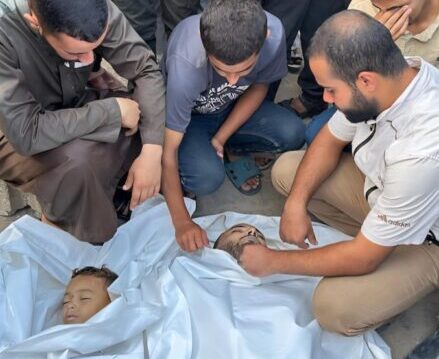
On the twelfth day of a fragile ceasefire, after 735 days of the genocidal campaign against the Palestinian people, Gaza continued to reel from the aftermath of intense Israeli bombing, shelling, and destruction as efforts to recover the dead and clear the rubble proceeded under dire conditions.
On Monday, a medical source at Baptist Hospital in Gaza confirmed that Israeli forces killed two Palestinians with live fire in the Shu’af area of the Tuffah neighborhood in eastern Gaza City. On Sunday, Israeli forces killed 44 Palestinians in a series of violations across the devastated Strip.
Rescue teams and emergency responders have recovered hundreds of bodies since the ceasefire took effect, but the scale of destruction and a critical shortage of heavy equipment have made recovery operations slow, dangerous, and often impossible in the most heavily damaged areas.
Palestinian teen Mohammed Zeineddin filmed what he thought would be his final goodbye after being targeted by two Israeli strikes.
Weeks on, he lives to tell the story of what happened pic.twitter.com/GiXH34ryZ6
— TRT World (@trtworld) October 20, 2025
Sources inside the Strip reported that emergency and rescue crews have extracted the bodies of 426 Palestinians from multiple locations since the truce began, a figure that underscores both the recent toll and the backlog of unrecovered victims trapped beneath collapsed buildings.
Civil Defense teams and frontline medics say they continue to encounter scenes of mass devastation: entire apartment blocks reduced to rubble, homes flattened, and streets choked by debris that block ambulances and stretcher teams.
In a parallel development, the Al-Qassam Brigades handed over on Monday the body of an Israeli whom they say was killed by Israeli forces during the indiscriminate bombing of Gaza, an exchange local officials said further highlights the complex and ongoing nature of the situation even amid the ceasefire.
Municipal and health officials stressed that such handovers are complicated by the absence of machinery capable of lifting heavy slabs and clearing deep layers of rubble, and by persistent insecurity around many of the worst-hit sites.
“The past 24 hours were devastating. We lost four people who were sheltering in an UNRWA school. A staff member lost her father, her mother, her brother and other family members. After two years of this,” UNRWA Sam Rose tells @BeckyCNN on @CNNConnect @CNN.
The suffering of the… pic.twitter.com/7W0JlH2IeS
— UNRWA (@UNRWA) October 20, 2025
Gaza’s mayor and other local leaders issued urgent appeals for heavy-lift equipment to retrieve those still missing beneath collapsed structures and to repair broken water lines that have left neighborhoods without safe drinking water.
The loss of water infrastructure has compounded public-health risks in an environment where hospitals and clinics are already strained; power outages and fuel shortages continue to disrupt surgical capacity, refrigeration of medicines and blood, and the operation of life‑saving equipment.
Hospitals across the Strip remain under extreme strain as they manage a continuous influx of severely injured patients while coping with damaged facilities and dwindling supplies.
Medical staff describe makeshift triage stations set up in courtyards and corridors, operating theatres working around the clock, and an urgent need for surgical supplies, anesthetics, and blood.
Ambulances and first responders face blocked roads and threats from unexploded ordnance, delaying evacuation times and reducing prospects for timely treatment of the critically wounded.
A Palestinian father painfully bids farewell to his child, killed in the Israeli attacks on Gaza yesterday. pic.twitter.com/IJYQiU8oKP
— PALESTINE ONLINE 🇵🇸 (@OnlinePalEng) October 20, 2025
Humanitarian organizations and local authorities warn that without immediate deliveries of heavy machinery, fuel, medical supplies and potable water, the humanitarian situation will deteriorate sharply.
Displaced families remain concentrated in overcrowded shelters and informal sites, while the risk of waterborne disease increases where sanitation systems have been damaged.
Municipal officials emphasized that clearing major roads and restoring water service are prerequisites for a sustainable humanitarian response and for enabling search‑and‑rescue teams to work more effectively.
The current situation leaves families waiting for news of loved ones, medics pleading for life-saving supplies and municipal teams calling for the practical tools needed to recover bodies and repair vital infrastructure.
Until heavy equipment, safe access and sustained humanitarian support are provided, those tasks will remain perilous and incomplete, prolonging the suffering of communities across Gaza.
Shirin Observatory For Human Rights reports that Israeli actions have now killed 70,919 Palestinians, including 20,178 children and 12,236 women, and that about 170,203 Palestinians have been injured, the majority of whom are children, women, and the elderly.
