
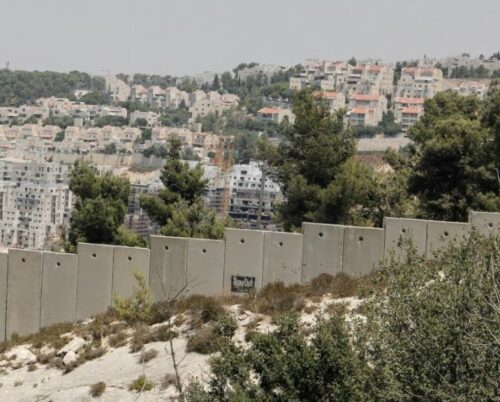
The Israeli occupation’s political‑security cabinet has approved the establishment of 19 new illegal colonies across the occupied West Bank, in a decision that represents the largest expansion in years.
The decision, taken late Thursday, includes the reestablishment of Ganim and Kadim, two colonies evacuated in 2005 under the Disengagement Plan from Gaza and northern West Bank.
The proposal was advanced by extremist Defense Minister Yisrael Katz and Finance Minister Bezalel Smotrich, who also oversees colonial expansion within the Ministry of Defense.
Smotrich announced a plan to allocate 2.7 billion shekels in the 2026 state budget to establish 17 additional illegal colonies over the next five years. The funds will cover infrastructure, public buildings, and caravans for colonizer absorption, as well as relocating military bases deeper into Palestinian territory.
Israeli media reported Friday that the approved list includes both previously established colonies and others already in advanced stages of construction.
The colonies approved are: Esh Kodesh, Al‑Lenbi, Givat Har’el, Ganim, Har Bezek, Ya’ar El Keren, Yatsiv, Yitav West, Kadim, Kokhav Hashahar North, Kida, Mash’ul, Nahal Doron, Bani Kedem, Reihanit, Rosh HaAyin East, Shalem, and Tamun.
The extremist colonial movement Nahala hailed the decision, describing the return to Ganim and Kadim as “an important step and a clear declaration that all of the land of Israel belongs to us.”
The group added that just as the government has now returned to colonies destroyed in the northern West Bank, it will eventually re‑establish “Jewish colonization” in Gaza.
The Palestinian Authority’s Wall & Colonization Resistance Commission condemned the move as “another step in the race to erase Palestinian geography in favor of the colonial project.”
Commission head Moayyad Sha’ban warned that the decision entrenches annexation and apartheid, undermining any prospect of a Palestinian state.
UN Secretary‑General António Guterres denounced the expansion, stressing that all Israeli colonies are illegal, null, and void under international law.
He warned that 2025 has already witnessed the largest colonialist drive since UN monitoring began, and linked the decision to escalating settler violence, noting that October 2025 was the worst month for West Bank attacks since records began in 2006.
Human rights groups emphasized that the expansion violates UN Security Council resolutions and the International Court of Justice ruling of July 2024, which declared Israel’s occupation illegal.
Israeli Peace Now movement described the move as de facto annexation, noting that more than 500,000 illegal colonizers live in West Bank colonies and another 250,000 in occupied East Jerusalem, making a two‑state solution virtually impossible.
This decision represents a major escalation in Israel’s colonial project, celebrated by extremist settler groups but condemned by Palestinians, the United Nations, and civil society organizations.
It underscores the systematic dismantling of Palestinian geography and sovereignty, while reinforcing international calls to hold Israel accountable for violations of humanitarian and international law.
All of Israel’s colonies in the occupied West Bank, including those in and around occupied East Jerusalem, are illegal under International Law, the Fourth Geneva Convention in addition to various United Nations and Security Council resolutions. They also constitute war crimes under International Law.
Article 33 of the Fourth Geneva Convention prohibits collective punishment and acts of terror against civilian populations.
Article 49 of the Fourth Geneva Convention states: “The Occupying Power shall not deport or transfer parts of its own civilian population into the territory it occupies.” It also prohibits the “individual or mass forcible transfers, as well as deportations of protected persons from occupied territory”.
Articles 53 and 147, prohibit the destruction of civilian property and classify pillage as a war crime.
