
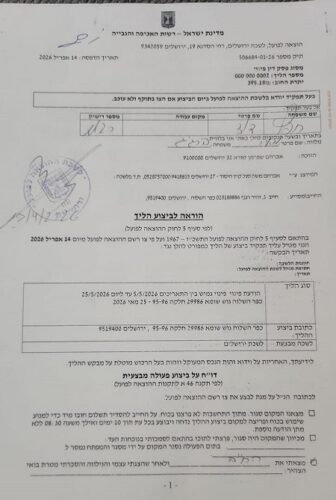
Expanded Report – Background & Context : Israeli occupation authorities invaded the Baten al‑Hawa neighborhood of Silwan, south of the Al‑Aqsa Mosque in occupied Jerusalem, on Thursday, and delivered forced‑eviction orders targeting seven Palestinian homes belonging to the Rajabi family, in favor of the colonial organization Ateret Cohanim, as part of an intensified campaign to seize Palestinian property and impose demographic control.
The Jerusalem Governorate reported that the families were given until May 17 to vacate, with Israeli forces threatening to carry out forced removal before May 25 if the families refuse.
This comes despite a pending appeal to freeze the orders, which Israeli authorities have ignored.
The seven apartments house:
- Zohair Rajabi (5 people)
- Osama Rajabi (7 people)
- Samer Rajabi (6 people)
- Munther Rajabi (7 people)
- Hazem Rajabi (9 people)
- Jadallah Rajabi (7 people)
- Fuad Rajabi (6 people)
These orders, in favor of colonizers, place those Palestinians are now at imminent risk of displacement.
|West Bank: Demolitions, Evictions, and Stop-Work Orders|
The Governorate noted that the move follows a major Israeli invasion on March 24, when occupation forces forcibly emptied 11 inhabited homes belonging to the Rajabi family — housing around 65 people — and evicted the family of Yousef Basbous, about 20 people, after illegal paramilitary Israeli colonizers seized their homes.
Baten al‑Hawa lies about 400 meters from the Al‑Aqsa Mosque and is one of the most aggressively targeted areas in Silwan, where colonial groups seek to link settlement outposts and tighten a demographic ring around the mosque.
Ateret Cohanim bases its claims on alleged Jewish ownership from 1881 over roughly 5.2 dunams of land, placing more than 84 Palestinian families—around 700 people—in prolonged legal battles before Israeli courts.
Since 2015, these claims — enabled by the discriminatory 1970 Legal and Administrative Matters Law — have placed more than 84 Palestinian families (around 700 people) under threat of eviction.
The law allows Jews to “reclaim” pre‑1948 properties while denying Palestinians the right to reclaim their own confiscated homes.
To date, these policies have resulted in the eviction of 39 Palestinian families from Baten al‑Hawa, with colonizers taking over their homes — part of a systematic effort to impose colonial facts on the ground.
These cases rely on the 1970 “Legal and Administrative Matters Law”, which permits Jews to “reclaim” pre‑1948 properties while denying Palestinians the right to recover their own confiscated homes.
Palestinian institutions and rights organizations describe Ateret Cohanim as one of the most aggressive colonial groups operating in occupied Jerusalem.
For decades, it has spearheaded efforts to take over Palestinian homes in Silwan and the Old City through fraudulent means, fabricated pretexts, and the backing of a biased Israeli judicial system.
Its activities are widely viewed as part of a long‑term strategy to reshape the demographic character of the city and entrench colonial control around Al‑Aqsa Mosque.
Ateret Cohanim’s ability to pursue evictions, seize Palestinian property, and install illegal paramilitary Israeli colonizers is sustained by a steady flow of funding from the United States.
At the center of this network is American Friends of Ateret Cohanim, a New York–based 501(c)(3) organization that channels millions of dollars in tax‑deductible donations to the group.
IRS filings show that the nonprofit reported $1.99 million in revenue in 2024, with 75.7% derived from direct contributions and 24.1% from fundraising activities. It listed $629,098 in assets, supported by a U.S. tax structure that enables donors to subsidize activities carried out in occupied East Jerusalem.
These funds support Ateret Cohanim’s legal teams pursuing eviction cases against Palestinian families in Silwan and the Old City, as well as property takeovers conducted through the “Jerusalem Reclamation Project,” a vehicle for expanding Israeli colonies inside Palestinian neighborhoods.
The donations also sustain institutions such as Yeshiva Ateret Cohanim, which plays a central role in promoting the ideological framework behind the organization’s colonization agenda.
Baten al‑Hawa, located about 400 meters south of Al‑Aqsa Mosque, is home to roughly 10,000 Palestinian residents and is among the most heavily targeted areas in Silwan.
The Jerusalem Governorate warns that the ongoing evictions aim to consolidate colonial control around Al‑Aqsa Mosque and link surrounding colonial outposts, deepening the suffering of residents, and threatening their fundamental right to housing.
The discriminatory legal framework governing property claims in Jerusalem is central to understanding the eviction cases unfolding in Baten al‑Hawa and other Palestinian neighborhoods.
The “Legal and Administrative Matters Law” underpins Ateret Cohanim’s claims to several dunams in the area and is routinely used to justify eviction proceedings against Palestinian families.
Palestinians, however, are categorically denied the same right. Homes, businesses, and agricultural lands they owned before 1948 — including extensive properties in West Jerusalem, Jaffa, Haifa, and other cities — cannot be reclaimed under Israeli law, even when families still hold original deeds.
These properties were placed under the authority of the “Israeli Custodian of Absentee Property” following the Nakba and were later transferred to the state or to Jewish institutions.
The Absentee Property Law of 1950 remains the primary mechanism preventing Palestinians from recovering these assets or receiving meaningful compensation.
This legal structure creates a one‑directional system: Jews may reclaim pre‑1948 property in East Jerusalem, while Palestinians are barred from reclaiming any of their pre‑1948 property anywhere.
Additional legislation, including the “Land Acquisition Law” of 1953 and administrative regulations governing so‑called “state land,” further entrenches this imbalance by enabling the state to seize Palestinian land for the expansion of Israeli colonies while severely restricting Palestinian construction and land registration.
Human rights organizations, UN bodies, and Palestinian legal institutions consistently describe this framework as a system of institutionalized discrimination designed to dispossess Palestinians and facilitate the transfer of their property to Israeli colonizer groups.
In neighborhoods such as Silwan, Sheikh Jarrah, and the Old City, these laws form the legal backbone of a long‑term strategy to reshape the demographic landscape of occupied Jerusalem and consolidate Israeli control around Al‑Aqsa Mosque.
All of Israel’s colonies in the occupied West Bank, including those in and around occupied East Jerusalem, are illegal under International Law, the Fourth Geneva Convention, in addition to various United Nations and Security Council resolutions. They also constitute war crimes under International Law.
Article 33 of the Fourth Geneva Convention prohibits collective punishment and acts of terror against civilian populations.
Article 49 of the Fourth Geneva Convention states: “The Occupying Power shall not deport or transfer parts of its own civilian population into the territory it occupies.” It also prohibits the “individual or mass forcible transfers, as well as deportations of protected persons from occupied territory”.
Articles 53 and 147, prohibit the destruction of civilian property and classify pillage as a war crime.
