
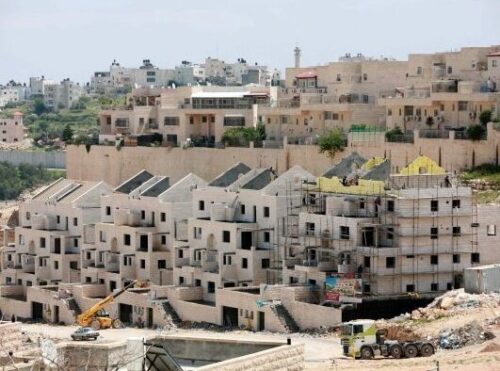
A report by Israel’s Channel 14 stating that land‑ownership claims have been “regularized” for the colonial council of Beit El, near Ramallah in the central occupied West Bank, has raised deep concern among Palestinian officials and international observers.
The move is widely understood as a preparatory step toward constructing 1,200 new colonial housing units, a development that is a direct violation of international law and another step in Israel’s ongoing policy of gradual annexation in the West Bank.
According to the report, the land process is intended to clear the way for expanding Beit El and reclassifying it from a settlement into a city.
Palestinian analysts say this shift is not administrative but strategic, aimed at reshaping the demographic and geographic reality around Ramallah in a way that undermines any future Palestinian territorial continuity.
Colonies and International Law
Under international law, all Israeli settlements in the occupied Palestinian territory are illegal. This position is grounded in a long series of United Nations Security Council resolutions:
- Resolution 242 (1967): prohibits acquiring territory by force.
- Resolution 338 (1973): reaffirms the legal basis for negotiations.
- Resolution 465 (1980): condemns settlement activity and calls for dismantling existing settlements.
- Resolution 2334 (2016): states that settlements “have no legal validity” and constitute a “flagrant violation under international law.”
The International Court of Justice, in its 2004 advisory opinion on Israel’s Annexation wall, also concluded that both the wall and the settlement enterprise violate the Fourth Geneva Convention, which prohibits an occupying power from transferring its civilian population into occupied territory.
Palestinian View: A Clear Step Toward Annexation
From a Palestinian perspective, the plan to expand Beit El fits into a broader pattern of settlement growth designed to create irreversible facts on the ground.
Similar expansions in Ariel and Ma’ale Adumim have already pushed these colonies toward city‑level status, integrating them into a larger urban network that fragments Palestinian land and restricts Palestinian development.
Expanding Beit El would significantly alter the area north of Ramallah, increasing pressure on surrounding Palestinian villages and tightening Israeli control over key corridors.
Palestinian officials describe this as a form of “silent displacement,” where demographic engineering gradually pushes Palestinians out without formal declarations of expulsion.
Israeli Political Messaging
Israeli Finance Minister and Minister of Settlements Bezalel Smotrich welcomed the plan, calling it a “national and historic duty.”
His remarks underscore that the project is not simply a planning decision but a political message: Israel intends to continue expanding its settlement enterprise despite international objections, and direct violations of International Law.
The construction of 1,200 new units would bring thousands of new settlers to the area, creating a large colonial population center in a strategically sensitive location near Ramallah.
International Response
The European Union and the United Nations continue to affirm that colonialist construction is illegal and undermines the two‑state framework.
The EU has recently imposed sanctions on settlers involved in violent attacks against Palestinians, while the UN maintains that any changes to the 1967 lines are not recognized unless agreed upon through negotiations.
Diplomatic observers say the Beit El expansion will likely draw further criticism, though Israel has historically moved forward with settlement plans regardless of international pressure.
A Strategic Escalation, Not a Routine Expansion
The plan to transform Beit El into a city is widely viewed as a strategic escalation—a deliberate effort to entrench the settlement enterprise, reshape the demographic landscape, and advance de facto annexation.
From both Palestinian and international perspectives, the project represents a serious deepening of settlement entrenchment and a direct challenge to international law.
