
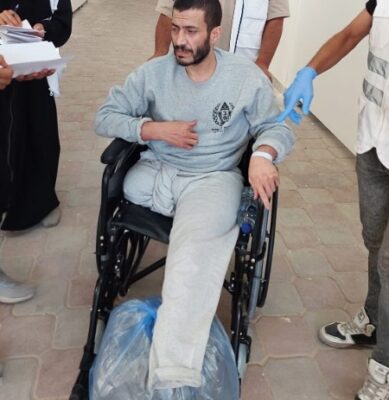
On October 13, 2025, Israel released 1,968 Palestinian political prisoners and detainees as part of a ceasefire agreement brokered by Egypt and Qatar.
The deal, described by regional mediators as the most comprehensive since the genocide on Gaza began in October 2023, includes the phased withdrawal of Israeli forces, mutual release of captives, and the immediate restoration of humanitarian aid to the besieged enclave.
Among those released were 250 prisoners serving life sentences, many of whom had spent decades behind bars.
The majority, 1,718 detainees, were from Gaza, abducted by Israel since October 7, 2023. The release marks the third and largest exchange since then.
The Palestinian Commission for Detainees’ Affairs and the Palestinian Prisoners’ Society have confirmed that previous deals saw the liberation of 240 captives in November 2023 and 1,777 in early 2025, bringing the total number of released individuals to 3,985.
In southern Gaza, thousands of Palestinians gathered in Khan Younis to welcome the first wave of freed detainees.
Calls are mounting for the release of Gaza’s Dr Hussam Abu Safia, who remains detained and reportedly tortured in Israeli prison after being abducted by Israeli forces last year https://t.co/4bK1N9IoT8 pic.twitter.com/fERO5zAj8K
— Al Jazeera English (@AJEnglish) October 14, 2025
Buses arrived at the Nasser Medical Complex, where families embraced loved ones after years of separation.
Meanwhile, 250 life-sentenced prisoners were transferred to the occupied West Bank, East Jerusalem, and abroad.
The ceasefire’s first phase took effect at noon on Friday, following its approval by the Israeli cabinet. In a parallel development, the Al-Qassam Brigades, the armed wing of Hamas, released 20 Israeli captives in two separate batches earlier that day.
 Among the released Palestinian political prisoner were 19 detainees from the Hebron district, one of the most heavily targeted areas in terms of long-term imprisonment.
Eleven of them were forcibly expelled to Gaza or abroad, while eight returned to their homes after years of imprisonment. Leading the list is Alauddin Fahmi Fattah al-Karaki, abducted in December 1993 and held for 32 years. His removal from his hometown was described by Palestinian officials as a form of “double punishment.”
The list of expelled detainees includes Osama Mohammad Idris al-Saeed (detained since 2001), Wael Hijazi Abu Shakhdam (2002), and Maher Hamdi al-Hashlamoun (2014), among others.
Those who returned home include Yasser Ayoub Asfour (detained since 2006) and Mohammad Hussein Abu Hadid (abducted in March 2025). Hebron continues to be one of the most affected districts, with hundreds of residents still held in Israeli prisons.
1968 captives freed.
77 killed by Israel in Israeli detention centers over the past two years.
Over 10,000 remain unlawfully held captive.
360 children remain behind bars. pic.twitter.com/d0Dvb5vhzo
— State of Palestine (@Palestine_UN) October 13, 2025
A joint statement from Palestinian institutions condemned the conditions endured by those released.
Many bore visible signs of torture, particularly detainees from Gaza, with documented cases of abuse continuing until the moment of release.
Families in the West Bank and Jerusalem were reportedly subjected to organized intimidation campaigns aimed at suppressing public celebrations and media appearances. Human rights groups have recorded at least 70 re-arrests of previously released individuals, some of whom remain in detention.
Our prisoners also have families, children, homes, and dreams.
Welcome home.
Still more than 10,000 captives are unlawfully held by Israel. Call for their release. pic.twitter.com/xsemK39Y9j
— State of Palestine (@Palestine_UN) October 13, 2025
Since October 2023, Palestinian detainees have faced systematic violations that rights organizations—including Human Rights Watch and Physicians for Human Rights—say amount to war crimes and crimes against humanity.
These include physical and psychological torture, deliberate medical neglect, solitary confinement, sexual violence, and the use of disease outbreaks—such as scabies—as a form of medical abuse. At least 78 detainees have died in custody since the genocide began, with several cases still under enforced disappearance.
Testimonies from released Palestinian prisoners continue to reveal the scale of the humanitarian catastrophe inside Israeli prisons.
The occupation deliberately tortures and mistreats prisoners, depriving them of their most basic rights, leaving them in physical and… pic.twitter.com/X6urlBBrEH
— Quds News Network (@QudsNen) October 13, 2025
Following this latest exchange, more than 9,100 Palestinians remain imprisoned in Israeli detention centers, excluding those held in military camps. Among them are 52 women and approximately 400 children.
Palestinian institutions have renewed calls for international legal intervention, urging global human rights bodies to break their silence. They demand immediate access for the International Committee of the Red Cross to all detention facilities and an end to the enforced disappearance of Gaza detainees.
This moment, while marked by relief and reunion, also underscores the enduring trauma of mass incarceration and the urgent need for accountability. As one freed detainee told Al Jazeera, “Freedom is not just release—it’s the right to live without fear, without torture, and without being forgotten.”
