The amount of aid entering Gaza remains minimal and far from sufficient to meet the immense humanitarian needs of the population. Israeli authorities continue to refuse to allow the entry of the amount of aid needed.
Journalist Hind Khoudary reports that much of what is entering the Strip consists of commercial trucks carrying goods for sale rather than essential relief supplies.
Deputy Spokesman for the UN Secretary-General Farhan Haq said at a press conference Wednesday that the Israeli Government Coordination Unit in the Palestinian Territories had informed the UN that it would cut in half the number of humanitarian aid trucks going to Gaza, from 600 to 300, on the pretext that Hamas had not returned the bodies of Israeli prisoners.
On Thursday, Hamas returned four additional bodies to Israeli authorities. But the amount of aid has not increased, and remains vastly insufficient for the needs of the starved population of the Gaza Strip.
Haq explained that the UN wants as much aid as possible to reach Gaza, saying: “We call on all parties to abide by their agreements, including the return of the bodies of dead prisoners and the implementation of the remaining terms of the ceasefire, including the delivery of humanitarian aid.”
Tom Fletcher, U.N. undersecretary-general for humanitarian affairs and emergency relief coordinator, said in a statement, “As Israel has agreed, they must allow the massive surge of humanitarian aid — thousands of trucks a week — on which so many lives depend, and on which the world has insisted.” He said more Gaza crossings need to open and “facilitating aid is a legal obligation.”
According to ABC News, Tess Ingram, communications manager for UNICEF, told their reporter, “We’re not asking for anything unreasonable. We’re asking for the volume of aid that entered Gaza Strip before the escalation in October 2023. I think that’s something to watch for in the coming days. Does the aid flow? Are the crossings open? Is the U.N. enabled to do its job, to serve the children of Gaza?. … But the other part is, does the ceasefire hold? The stakes are really high right now, so that ceasefire has to hold.”
Israeli authorities are still maintaining the naval blockade, preventing entry of any aid or goods from the Mediterranean Sea that borders the west coast of Gaza. Israel controls 53% of the tiny coastal Strip, and has a military blockade on all borders of the Gaza Strip.
Meanwhile, the Speaker of Parliament of the Greek Republic, Nikitas Kaklamanis, confirmed the Greek government’s readiness to provide additional humanitarian aid and receive more wounded children from the Gaza Strip to receive treatment in Greek hospitals.
Meanwhile, the Greek Minister of Foreign Affairs and Expatriates, Farsin Agabkian Shaheen, who stressed the importance of continuing the flow of humanitarian and relief aid to the people of the Gaza Strip, and the necessity for countries to take the initiative to develop and implement practical plans for reconstruction, in a way that contributes to making Gaza a viable region again.
Minister Shaheen also called for investing international momentum to achieve a comprehensive and just peace that includes the entire Palestinian territories, stressing that global recognition of the State of Palestine on the 1967 borders.
She also stressed the importance of accelerating the delivery of humanitarian aid from around the world to the Gaza Strip, given the urgent humanitarian need there, emphasizing that all support provided contributes to alleviating the suffering of the Palestinian people and embodies the depth of human solidarity and popular ties among peoples.
Colombian President Gustavo Petro, known for his unwavering support for Palestine, has pledged to send aid to Gaza in the form of gold confiscated from traffickers and smugglers in Colombia.
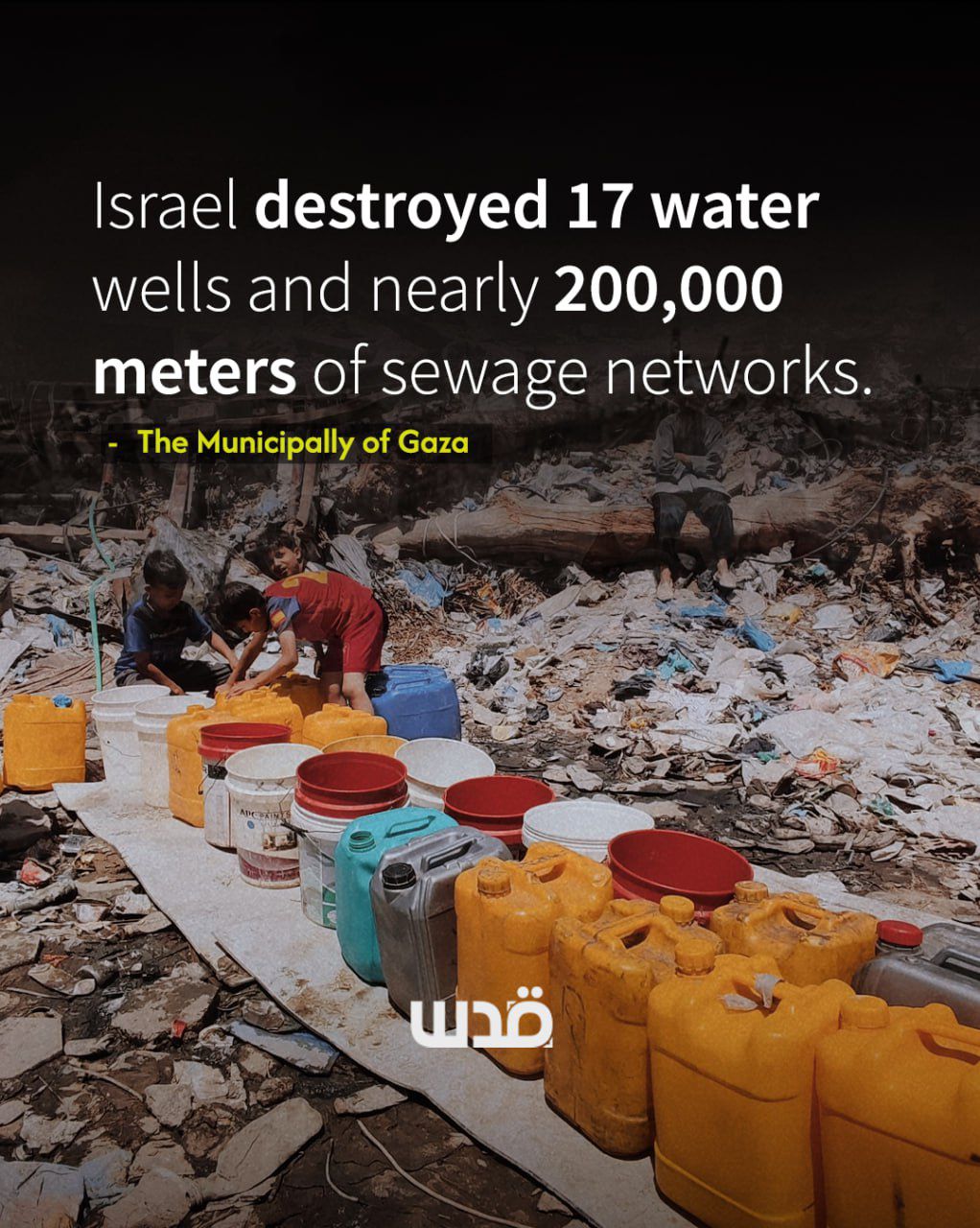
In addition to the massive shortage of food, the Gaza Strip is also facing an Israeli-created water crisis.
Over the past two years, Israel has destroyed 17 water wells in Sheikh Radwan, Tel al-Hawa, and Shujaiya, cutting water access for 80% of Gaza City’s residents, according to engineer Maher Salem, Director General of Planning at Gaza Municipality, in a statement to Al-Araby Al-Jadeed.
More than 200,000 meters of sewage networks were also destroyed, raising fears of widespread sewage floods as the rainy season approaches.