
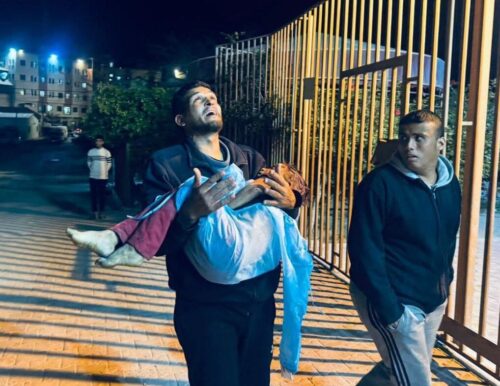
Israeli airstrikes killed four Palestinians, including three members of one family, and wounded others on Sunday in the central and southern Gaza Strip, while an evening attack killed nine Palestinian police officers, bringing the total number of Palestinians killed in the past 24 hours to at least fifteen. Two women and one child were also killed when a wall collapsed on them.
The strikes come amid continued bombardment across the Gaza Strip and growing warnings from UN agencies about the collapse of humanitarian conditions.
Medical sources have confirmed that three members of the same family were killed when Israeli warplanes struck a gathering of civilians in the al‑Sawarha area west of the Nuseirat refugee camp in the central Gaza Strip.
The victims were identified as Kamel Ayyash, his wife Halima, and their son Ahmad. Several others were wounded in the same attack.
In Khan Younis in the southern Gaza Strip, two women and one child were killed when a section of the wall of the Ribat College building that was targeted in a previous Israeli bombing collapsed onto tents sheltering displaced families in the al‑Mawasi coastal area.
🚨Breaking: The mercenary David Mcintosh, who served with a U.S. aid company, released more footage showing Israeli snipers and machine gunners firing on starving civilians waiting for food for hours. During the famine, +2,000 Palestinians were killed trying to reach aid sites. pic.twitter.com/L4RKhEO1tj
— Ramy Abdu| رامي عبده (@RamAbdu) March 14, 2026
The victims were identified as Intisar ‘Odah Abu Dan, 65, Tasneem Iyad Barbakh, 19, and Husni Rafat Husni Abu Taha, 5. Medical teams confirmed that the child, Husni Abu Taha, died instantly when the concrete wall gave way, crushing several tents beneath it.
The Gaza Ministry of Health reported that hospitals in the central governorate received five Palestinians killed (four newly killed and one who died of earlier wounds) and eight wounded in the past 24 hours.
The Ministry added that an unknown number of victims remain trapped under rubble and in areas rescue teams cannot reach due to ongoing bombardment and the collapse of civil defense capacity.
Separately, medical sources confirmed the death of Wafi Talal Ibrahim al‑Dasouqi, who succumbed to wounds sustained in an Israeli airstrike on January 30.
The latest strikes come as UN agencies continue to warn that conditions in Gaza have deteriorated beyond what humanitarian systems can sustain.
Breaking: As debris-removal equipment continues to be blocked from entering Gaza, a wall of Al-Ribat College near Street 5 in Khan Younis collapsed onto displaced civilians, causing many deaths and injuries, with victims transported in civilian cars. pic.twitter.com/4LEvpV4zRn
— Ramy Abdu| رامي عبده (@RamAbdu) March 15, 2026
UNRWA stated this week that “Gaza has become unlivable,” noting that repeated displacement, the destruction of civilian infrastructure, and the collapse of basic services have left families with “nowhere safe to go.”
The agency reported that many displaced families in Khan Younis and Rafah are living in makeshift tents, plastic shelters, or damaged buildings, with limited access to clean water, food, or medical care.
The UN Office for the Coordination of Humanitarian Affairs (OCHA) reported that ongoing bombardment has severely restricted the movement of humanitarian convoys, warning that “the ability to deliver aid is now almost entirely dependent on temporary pauses in fighting,” and that many areas remain inaccessible to rescue teams.
🚨Gaza’s children are growing up amid war, pain, and survival.
As Israel’s ongoing war devastates the Strip, many children are forced into labor to help their families survive, reflecting the deep social impact the war continues to leave on Gaza’s youngest generation. pic.twitter.com/ijgdwPfSWB
— Gaza Notifications (@gazanotice) March 14, 2026
The UN Secretary‑General reiterated that the protection of civilians is an obligation under international humanitarian law, stressing that the repeated strikes on residential areas, shelters, and displacement sites “underscore the urgent need for sustained humanitarian access and the protection of all civilians.”
Sunday’s fatalities follow the earlier Israeli strike documented attack, in which nine Palestinian police officers were killed in central Gaza.
🥺👇
A little girl tries to play,
after the occupation amputated her leg… 💔🥺
A childhood that was meant to run and laugh,
but today she is learning how to stand again on a deep wound.
Despite the pain, in the eyes of our children there remains a strength and patience that… pic.twitter.com/a5GTREm0Bs— Sameh Ahmed 𓂆 🇵🇸 (@PalPress24) March 14, 2026
Medical teams say the continued bombardment, combined with the collapse of Gaza’s health system, is pushing hospitals beyond their remaining capacity, with shortages of fuel, equipment, and staff limiting their ability to treat the wounded.
According to the latest Health Ministry report, the total number of Palestinians killed since the declared “ceasefire” on October 11, 2025, has risen to 663, while the number of wounded has reached 1,762. Civil defense teams have also recovered 756 bodies from beneath destroyed homes and buildings.
Since the beginning of the genocide in Gaza on October 7, 2023, the cumulative toll has reached at least 72,239 Palestinians killed and 171,861 wounded, the Health Ministry said.
