
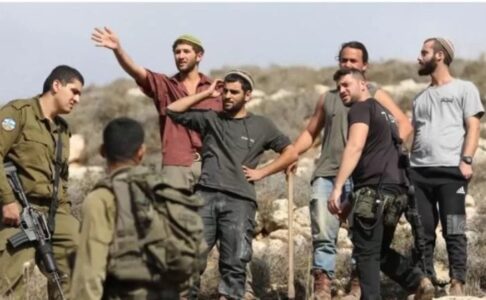
Illegal Israeli colonizers forcibly removed two Palestinian Bedouin families on Friday from the Shallal al-Auja area, located north of Jericho in the northeastern part of the occupied West Bank.
The families of Ayed Mousa Ka’abna and Ibrahim Ayed Ka’abna, were violently assaulted and threatened with death, ultimately forcing them to abandon their homes.
Hassan Mleihat, who heads the Al-Baydar Organization for the Defense of Bedouin Rights, stated that armed colonizer groups encircled the families’ dwellings, beat them severely, and issued direct threats to kill them if they remained.
He described the incident as “among the most brutal forms of terrorism,” emphasizing the calculated use of violence to uproot native inhabitants.
According to Al-Baydar and multiple rights organizations, colonizers have recently installed new colonial outposts just 300 meters from the homes of Shallal al-Auja residents.
These colonialist expansions have unleashed a relentless campaign of intimidation, including repeated intrusions, destruction of property, and psychological terror, all designed to drive families off their land.
This latest expulsion reflects a broader pattern of colonizer aggression and forced displacement across Area C of the West Bank, where Palestinian communities are increasingly targeted by state-supported colonial expansion.
Legal experts and human rights advocates warn that such actions violate international humanitarian law, particularly the prohibition against forcible transfer under the Fourth Geneva Convention.
On Friday evening, Israeli colonizers invaded Sinjil town, north of the central West Bank city of Ramallah, and fired many live rounds at Palestinians who intercepted their attackl.
The West Bank is fragmented into three zones, Areas A, B, and C, based on the Oslo II Accord signed in 1995.
Though intended as interim arrangements, these divisions remain in force and continue to shape the daily realities of Palestinian life:
- Area A: Encompassing roughly 18% of the West Bank, and includes key Palestinian cities such as Ramallah, Nablus, Bethlehem, and Jericho. It is nominally under full civil and security control of the Palestinian Authority. However, Israeli military incursions occur regularly, undermining any semblance of sovereignty.
- Area B: Covering about 22% of the territory, Area B consists of numerous Palestinian towns and villages. Civil affairs are managed by the Palestinian Authority, while Israel maintains overriding control over security. This dual governance often results in fragmented administration and limited infrastructure development.
- Area C: Making up nearly 60% of the West Bank, Area C is under complete Israeli control—both civil and military. It includes all Israeli colonies, military zones, and large areas designated as state land or nature reserves.
Although hundreds of thousands of Palestinians reside in Area C, they face systematic restrictions on construction, access to resources, and basic services. Israeli authorities rarely approve building permits for Palestinians, and demolitions are frequent.
Area C remains the epicenter of colonial expansion, land confiscation, and settler violence, making it one of the most volatile and contested regions in the occupied territory.
On Wednesday, the Israeli occupation issued six tenders for the construction and expansion of colonial project, totaling around 4,000 units in the illegal colonies of “Ariel” in Salfit Governorate and “Ma’ale Adumim” in the Jerusalem Governorate.
Last Friday, Israeli occupation authorities compelled a Palestinian resident to carry out the demolition of his own home in the town of Sur Baher, located south of occupied East Jerusalem.
All of Israel’s colonies in the occupied West Bank, including those in and around occupied East Jerusalem, are illegal under International Law, the Fourth Geneva Convention in addition to various United Nations and Security Council resolutions. They also constitute war crimes under International Law.
Article 49 of the Fourth Geneva Convention states: “The Occupying Power shall not deport or transfer parts of its own civilian population into the territory it occupies.” It also prohibits the “individual or mass forcible transfers, as well as deportations of protected persons from occupied territory”.
