
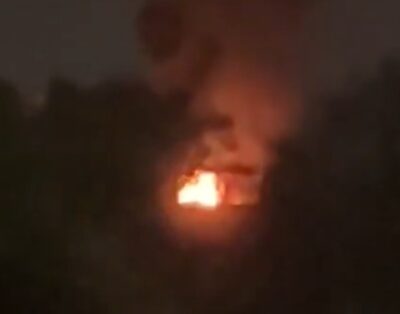
Illegal paramilitary Israeli colonizers invaded the village of Burqa, east of Ramallah in the occupied West Bank’s central part, on Monday evening and set fire to several olive trees near Palestinian homes.
Local sources reported that the colonizers targeted the al-Hadab area on the western side of the village, adjacent to residential houses.
Despite rainfall, the olive trees ignited quickly, indicating the use of highly flammable materials. The fires posed a direct threat to nearby homes.
Burqa, like other villages in the Ramallah and al-Bireh governorate, has been subjected to continuous colonizer assaults, including arson attacks on trees and property damage, as part of a broader policy aimed at pressuring residents and seizing their land.
In related news, Israeli colonizers closed the Jaba’ roundabout, north of occupied Jerusalem, on Sunday evening, obstructing Palestinian movement.
Witnesses reported that groups of colonizers gathered at the roundabout under the protection of Israeli occupation police. They set up a large Star of David structure in the middle of the junction, blocking traffic and disrupting the movement of vehicles.
The closure of Jaba’ roundabout forms part of a broader pattern of colonizer actions in and around occupied Jerusalem, where Palestinian residents face repeated restrictions on movement, intimidation, and disruption of daily life under occupation.
Earlier Monday, Israeli colonizers invaded Islamic shrines in the town of Awarta, southeast of Nablus in the northern West Bank.
Local sources reported that Israeli occupation forces invaded the village, forcing shop owners to close their businesses. Shortly afterward, several buses carrying hundreds of colonizers entered Awarta and proceeded to the shrines under heavy military protection.
According to the Wall & Colonization Resistance Commission, Israeli occupation forces and colonizers carried out 2,144 attacks during November alone.
Of these, the army committed 1,523 assaults, while colonizers carried out 621 attacks. The majority were concentrated in the following governorates:
- Ramallah and al-Bireh: 360 attacks
- Hebron, in the southern West Bank: 348 attacks
- Bethlehem, in the southern West Bank: 342 attacks
- Nablus, in the northern West Bank: 334 attacks
These figures underscore the intensifying campaign of violence and land seizure across the occupied West Bank, leaving Palestinian communities facing daily threats to their safety, property, and livelihoods.
