
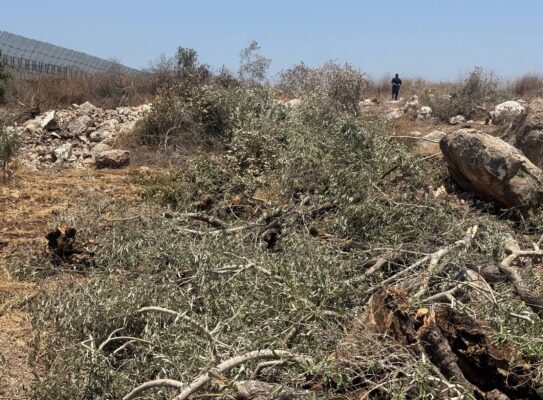
Israeli occupation forces carried out widespread invasions across the occupied West Bank on Wednesday, breaking into homes, abducting residents, uprooting trees and imposing movement restrictions in several districts.
In Hebron, in the southern West Bank, soldiers invaded homes in the refugee camps of Al‑Fawwar and Al‑Arroub, breaking into residences and abducting Mahmoud Al‑Qawasma, Hamza Majed Salmi, and Ibrahim Ayman Ayyad.
Troops also invaded the town of Beit Ummar, north of Hebron, where they broke into the home of local media activist Mohammad Ayyad Awad and caused extensive damage to its contents.
In the same governorate, a paramilitary Israeli colonizer attacked a family home in the area of Khallet Thieb near the Annexation Wall west of Beit Oula. Soldiers then abducted Mahmoud Hussein Al‑Elma and ordered the family to leave their land.
In the Bethlehem district, Israeli forces invaded the Dheisheh refugee camp south of the city, firing concussion grenades and toxic gas at residents, causing multiple cases of inhalation injuries.
In the central West Bank, soldiers invaded the villages of Abwein and Deir Jarir in the Ramallah governorate, deploying infantry and military vehicles through residential areas.
Troops also closed the main entrance to the village of Al‑Mughayyer, north‑east of Ramallah, with a military vehicle and blocked residents’ movement.
Later, forces invaded the area surrounding Birzeit University north of Ramallah, positioning military vehicles at one of the campus gates. Confrontations erupted in Al‑Mughayyer as soldiers fired gas canisters at residents.
In occupied Jerusalem, Israeli forces invaded the town of Rafat, north‑west of the city, accompanied by bulldozers that entered through the eastern gate of the Annexation Wall near Qalandiya. No detentions were reported.
Later in the evening, soldiers invaded the town of Hizma, north‑east of occupied Jerusalem, abducting an unidentified resident after deploying through several neighborhoods and breaking into the Tablas area.
In Nablus, in the northern West Bank, twelve military vehicles invaded the village of Al‑Lubban ash‑Sharqiya, focusing their operations in the Wadi Abwein area.
Additional forces invaded from the direction of Abwein. Soldiers closed the road between Al‑Lubban ash‑Sharqiya and Ammuriya and deployed heavily at the village’s eastern entrance and along the Khallet Zeina road.
In Jenin, in the northern West Bank, Israeli forces invaded the village of Anza and abducted Talal Obeid after breaking into the village.
Troops spread through the streets, stopped civilian vehicles, searched them, and interrogated passengers. Forces also continued their presence in the town of Qabatia south of Jenin.
In Tulkarem, in the northwestern West Bank, Israeli forces abducted six residents during an early‑morning invasion of the city’s southern neighborhood: Allam Barouq and his son Rami, former political prisoners Omar Yaqub Shannar, Islam Osama Al‑Sa’i, and Nafez Dheeb Abu Obeid, along with Zahdiya Rabah Bodeir, who was taken from her home in the nearby town of Far’un.
In the town of Qaffin, north of Tulkarem, soldiers uprooted dozens of olive trees near the Annexation Wall.
In Qalqilia, in the northwestern West Bank, Israeli forces abducted fifteen laborers from Gaza after invading the western part of the city, including the Naqqar neighborhood and Abu Ali Eyad roundabout.
Soldiers broke into a structure where the workers were staying, assaulted them, and abducted fifteen before withdrawing.
Troops also invaded the nearby village of Azzun Atma, set up a military roadblock, stopped civilian vehicles, and broke into several homes, including that of Hamed Haroun, before withdrawing without additional detentions.
This report documents only a portion of the violations carried out by Israeli forces and illegal paramilitary colonizers across the occupied West Bank, including occupied Jerusalem.
Many incidents remain unreported or inaccessible due to ongoing military restrictions, the presence of armed colonizers, and the continuous escalation of attacks, making comprehensive monitoring and documentation increasingly difficult.
