
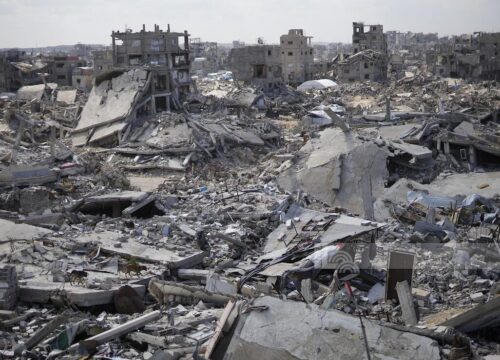
Israeli occupation forces continued to violate the declared “ceasefire” in the Gaza Strip on Saturday through sustained airstrikes, artillery shelling, and heavy gunfire, while simultaneously tightening the siege and further restricting the entry of goods and humanitarian aid, deepening an already catastrophic humanitarian situation.
Media sources reported that Israeli military vehicles opened fire toward the eastern areas of Khan Younis, while Israeli naval vessels fired live rounds off the coast of the city, forcing fishermen and displaced families sheltering near the shore to flee.
In southern Gaza, Israeli artillery targeted the western neighborhoods of Rafah, sending smoke over residential areas already devastated by months of bombardment and forced displacement.
In Gaza City, Israeli armored units fired intensively toward the eastern edges of the Tuffah neighborhood, where occupation forces also carried out a demolition operation in the surrounding eastern zones, part of a pattern of repeated incursions and destruction inside areas that were previously declared “safe” under the ceasefire framework.
The Palestinian Ministry of Health said seven Palestinians were killed and twenty‑six injured during the past forty‑eight hours, including four newly documented fatalities and three bodies recovered from beneath the rubble.
Since the “ceasefire” announcement of October 11, 2025, the Ministry has documented 828 Palestinians killed, 2,342 injuries, and 767 bodies recovered from destroyed neighborhoods.
The cumulative toll since the beginning of the Israeli genocide on October 7, 2023, has now reached 72,608 Palestinians killed and 172,445 injuries.
Health officials warned that the continued Israeli attacks, combined with the near total collapse of the health system, mean that many wounded Palestinians are dying from treatable injuries due to the absence of surgical capacity, electricity, medical supplies, and safe transport to functioning hospitals.
This Palestinian father in Gaza is teaching his son how to fish.
Thousands in Gaza made their living by fishing before Oct. 2023, and fish has been a vital source of food during the genocide. pic.twitter.com/uYSysvMYwJ
— AJ+ (@ajplus) May 2, 2026
Humanitarian agencies warned again this week that the situation in Gaza remains untenable despite the ceasefire announcement.
UNRWA stated in its most recent update that the Strip is experiencing “unlivable conditions,” with aid convoys facing daily obstruction and shelters operating far beyond capacity, many without functioning sanitation or clean water.
OCHA reported that large sections of northern and central Gaza remain inaccessible to humanitarian teams due to ongoing Israeli military activity, damaged roads, and the absence of guaranteed safe passage, leaving thousands of families without food, medical supplies, or the ability to reach hospitals.
Engine oil is essential to keep generators and vehicles running. Without it, hospitals, water systems and transport come to a halt, putting lives at risk.
🚨 In Gaza, engine oil supplies are rapidly depleting as Israeli authorities restrict its entry. In the coming weeks, some… pic.twitter.com/XG3XOEOENK
— MSF International (@MSF) May 1, 2026
The UN Secretary‑General reiterated that Gaza’s civilian population continues to face one of the most severe humanitarian crises in recent decades, calling for immediate, unhindered humanitarian access and protection of civilians, particularly in areas repeatedly struck despite the ceasefire.
Medical officials in Gaza say the continued Israeli attacks, combined with the collapse of the health system, have left hospitals operating with minimal capacity, limited electricity, and severe shortages of essential medicines and surgical supplies.
Ambulance crews and civil defense teams report that they are frequently unable to reach injured Palestinians due to ongoing fire, destroyed roads, and the targeting of rescue teams in previous incidents.
Residents across Gaza stressed that the renewed Israeli attacks, combined with the tightening siege, demonstrate that the ceasefire has not translated into safety on the ground, as communities continue to face bombardment, displacement, and the systematic destruction of homes and infrastructure.
