
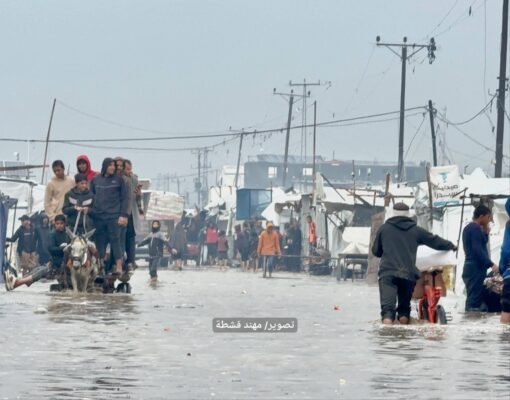
Israeli occupation forces killed a Palestinian Tuesday morning in shelling east of Khan Younis, in southern Gaza, while heavy rains at the same time flooded displacement camps, collapsing hundreds of tents and leaving families exposed to cold and disease.
The strike hit inside the so‑called “yellow line” — a ceasefire redeployment boundary Israel was meant to respect under the October 11 agreement.
Marked by concrete blocks and signs, the line was supposed to define areas of Israeli withdrawal, but residents say the army has repeatedly pushed beyond it, turning eastern neighborhoods into buffer zones and preventing families from returning.
Witnesses said the army kept firing through the morning — artillery, tank shells, and helicopter gunfire — in yet another breach of the ceasefire.
Rescue crews struggled to reach families in al‑Mawasi, Khan Younis, as dozens of tents collapsed under rain and floodwaters. Displaced residents said, “hundreds of shelters simply sank into the mud,” leaving families exposed to the cold.
Heavy rain also flooded the Kuwaiti Field Hospital in Gaza, inundating the surgery ward and forcing the facility to suspend operations until the water could be removed and the damage assessed.
On Monday, Israeli occupation forces killed four Palestinians and injured several others in artillery and drone strikes east of Gaza City and Khan Younis.
The genocide has already destroyed 92% of Gaza’s housing stock, forcing most people into fragile tents or cracked homes at risk of collapse during storms.
UN spokesperson Stéphane Dujarric warned that “thousands of displaced families are now fully exposed to harsh weather conditions, increasing health and protection concerns.”
The camps had become muddy basins. Children and the elderly shivered in the cold, with little more than thin blankets and worn clothes.
Aid groups say the flooding has worsened outbreaks of gastric illness and skin infections and warn that hundreds of thousands of displaced Palestinians face what officials call “the most dangerous humanitarian disaster” since the war began.
Humanitarian agencies stress the urgent need for emergency aid and protection to help families survive the harsh conditions. Since the so‑called “ceasefire” began on October 11, more than 344 Palestinians have been killed, with 871 wounded and 574 bodies retrieved from under the rubble.
Gaza’s Ministry of Health says the overall toll since October 7, 2023, has reached more than 69,513 killed and at least 170,745 injured, the vast majority women and children.
